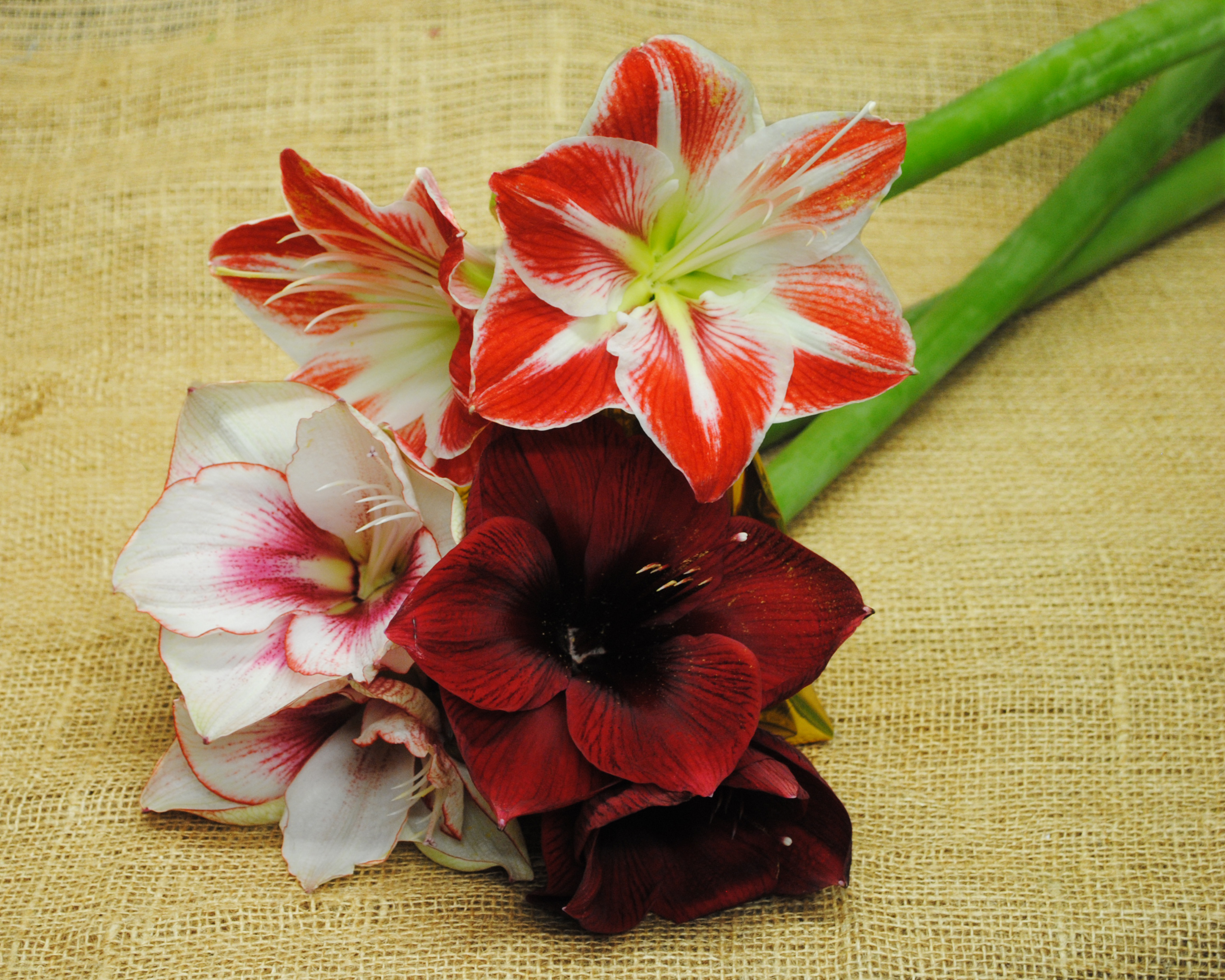
Starbright NYC Flower Files: Hippeastrum (aka Amaryllis)

Amaryllis
Hippeastrum (commonly called Amaryllis)

Hippeastrum aka Amaryllis


Quick Notes /

Surprise! This flower, commonly called Amaryllis, is actually a member of the Hippeastrum genus! For years, there was confusion among botanists as to the generic names Amaryllis and Hippeastrum. The debate, it seems began around 1738-1753 and was finally resolved by the 14th International Botanical Congress in 1987. The IBC decided that  the name Amaryllis would belong to the originally identified bloom regardless of common use. So what’s the difference? The Hippeastrum bloom is commonly preferred for it’s ability to bloom indoors during cold winter months in the northern hemisphere while it’s namesake bloom, the actual Amaryllis, grows natively outdoors South Africa and is more commonly referred to as a Lily (though Amaryllis and Lilium, “true lilies” are only very distantly related). This oddly twisted bit of floral folly took over two hundred years to come to terms with. So let’s all do ourselves a favor and just keep on calling this bloom (in all it’s varieties) by it’s common name.


Visual Notes /

These bold trumpet-shaped flowers grow from easy to plant bulbs. Their long hollow stems are accompanied by long flat, sword-shaped leaves. One stem can produce up to six blooms. The blooms range in color from deep bold red to the brightest white and include a number of interesting bi-colored varieties as well.

Flower History/

The name Amaryllis comes from the Idylls of Theocritus or the Eclogues of Virgil (click to read Theocritus’ Idylls). In this pastoral poem, Amaryllis is a sweetly-singing shepherdess who is in love with a cold-hearted man. Desperately, Amaryllis pierced her heart with a golden arrow then, inexplicably, trekked to his cottage day after day for an entire month, shedding drops of blood along the way. On the thirtieth day blood-red blooms blossomed from the drops, the man was enchanted by the flowers, Amaryllis’s heart was healed and they lived happily ever after.

Inside Info /
  • The US imports over 10 million Amaryllis bulbs a year.
  • The name Amaryllis comes from Greek “to sparkle”
  •  The name Hippeasrtum, also from Greek means “horseman’s star”.


Starbright Logo

Looking for flowers in New York City? Visit our Event Gallery for inspiration. Or see our daily selection at Starbrightnyc.com.

Celebrate the Holidays with Starbright NYC and Teleflora’s Homemade For The Holidays Collection

Nic and Jasmine at Starbright NYC

Starbright celebrates the holidays with Teleflora in New York City!

Hanging on various walls and scattered throughout the shop, are a number of plaques proclaiming Starbright Floral Design as one of the top 50 sellers in the Teleflora network. It’s a great place to be – in the Top 50 of a network including more than 15,000 member florists in the US and Canada. For over twenty years now, Starbright Floral Design has filled and sent orders to this network of talented florists. We’re all unique shops, many of us with our own unique styles, but together, with the stellar design direction of the Teleflora team florists all over are able to send exactly what you’re looking for. 

Earlier this week, Jasmine Corzo, a familiar face from the Teleflora design team, stopped into Starbright Floral Design with a camera crew, some clippers and a plan to introduce us to the Telefora holiday centerpieces and seasonal lineup collection for 2014.

Thomas Kinkade's Holiday Arrangement
Thomas Kinkade’s Meet Me Under The Mistletoe

The Teleflora arrangements this year remind us of being home for the holidays. The designs include traditional premium floral varieties, which bring out the colors of the season. Pieces like Teleflora’s Candy Cottage and Thomas Kinkade’s Meet Me Under The Mistletoe include winter greens like white pine and noble fir with snowy bright whites and velvety deep reds. Frosted pinecones and peppermint carnations, and big red berries are playful seasonal favorites that add great texture to these lush pieces. But it’s not just about the flowers!

Warm Wishes
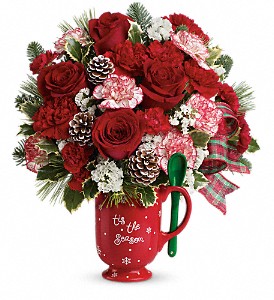
Teleflora’s Warm Holiday Wishes Bouquet
Candy Cottage
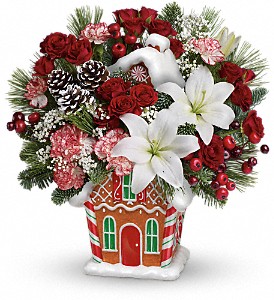
Teleflora’s Candy Cottage Bouquet

Many of the Teleflora holiday arrangements are made to fit a special seasonal keepsake. While the premium flowers used in these arrangements have a great vase life, the vase they come in will surely be a longtime favorite. You’ll want to bring these cookie jars, mugs, and decorative vases out year after year and reminisce about when Aunt Ana, Grandpa Redd, or your nephew Hugo sent you flowers.

But Wait! There’s more!

As if the fancy flowers and festive vases aren’t enough, sending any item from the Teleflora Homemade For The Holidays Collection comes with a chance to enter their Holiday Sweepstakes to win a trip to NYC!

Starbright Logo

Looking for flowers in New York City? Visit our Event Gallery for inspiration. Or see our daily selection at Starbrightnyc.com.

NYC Holiday Flower Files: Pointsettia

Poinsettia
Poinsettia

Poinsettia Facts

Poinsettia Quick Notes /

A popular floral symbol of the Christmas Season, Pointsettias are indigenous to Mexico and Central America. The poinsettia plant generally grows to be between two feet and thirteen feet tall. The common English name – poinsettia – comes from the last name of Joel Roberts Poinsett, the first United States Minister to Mexico. Mr. Poinsett introduced the plant to the US in 1825.

Poinsettia Visual Notes /

The large dark green dentate leaves grow lower on the stem than the colored bracts, which are often mistaken for petals. The colored bracts are available in white, cream, pale green, pink, orange, marbled, or the most popular – bright red. The color of the bracts is affected by photoperiodism. Photoperiodism is a physiological reaction caused by the length of daylight or night. Poinsettias are peculiar in that their bracts require at least twelve hours of darkness in order to change color, but also exposure to bright light to deepen the shade of the color. The flowers of the poinsettia are tiny and unassuming.  Their yellow structures cluster in the center of the leaves.

Poinsettia
Poinsettia


Poinsettia Flower History/

The poinsettia has been called many things over the years and around the globe. The original name for the poinsettia plant is Cuetlaxochitl, which is Nahuatl for “flower that grows in residues or soil”. The ancient Aztec used the Cuetlaxochitl bracts for their red dye and as a medicine. In Mexico, the poinsettia is called flor de noche buena or “Christmas Eve flower” while in some other Spanish speaking countries it is called flor de pascua or “Easter flower”.  In Egypt, the name Bent El Consul translates as “the consul’s daughter” – in honor of Mr. Poinsett.

In the US, the poinsettia was popularized by the Ecke family in California who first sold poinsettia plants at street stands during the Holiday Season. After three generations of cultivating the plants, Paul Ecke Jr. solidified the plants Holiday association by sending free poinsettia plants to television stations from Thanksgiving to Christmas to be displayed on the air.

Poinsettia Inside Info /

  • Keep your poinsettia healthy by following these pointers
    • Water the soil when it begins to dry (aim for moist, but not soggy).
    • Keep the plant away from hot or cold drafts (a general temperature of 60-70 degrees fahrenheit is best)
    • Expose the plant to natural light
  • Despite popular belief, the Poinsettia is not poisonous – it’s been cleared of all charges by the American Medical Association.
  • Poinsettia plants will change color year after year with a little bit of work. Beginning in October, stash your plants in total darkness from 5pm to 7am and then expose them to full sun. Repeat every day and in eight to ten weeks, your poinsettia bracts should be changing color.


Starbright Logo

Looking for flowers in New York City? Visit our Event Gallery for inspiration. Or see our daily selection at Starbrightnyc.com.
The Starbright Team – Barbara


Barbara

We spent some time recently getting to know the office staff of Starbright NYC. Today, we’d like to introduce you to a special office member who also holds it down on the design table – Barbara:

How many years have you been working at Starbright? Can you mention something about when you started? 

[Barbara Mele] I’ve been here since 2009, so five years. I started as a freelancer, to assist with one of Starbright’s biggest and most beautiful weddings ever. It was at the Brooklyn Museum of Art.

What is you position at Starbright? 

[Barbara Mele] Design and Events Manager


If you take sales calls, what is your favorite advice to give the undecided client looking for a (1) romantic arrangement or (2) something to give to a guy or (3) in general.

[Barbara Mele] 1) People have varying ideas of “romantic”- it isn’t always red roses! So it is good to discuss a little bit what kind of romantic they have in mind. Classic? Modern? Soft? Then use those descriptives to shape the design and what varieties are involved. 2) For guys, you can not go wrong with primary colors. You don’t necessarily have to use red, blue AND yellow- it can be only two of those- but try to break up red and yellow with some green or orange, so it doesn’t look ketchup and mustard. 3) Even the most indecisive client has an idea of what they want, you just have to help them find it. A designer can take her cues by asking about the recipient or sender’s favorite color, flower, season, holiday, adjective, place to visit…there are so many sources of inspiration!


What’s your favorite flower? color?

 [Barbara Mele] I have many, many favorites. A long time favorite has been lily of the valley. My favorite color is Orange.


What’s your favorite floral style?

[Barbara Mele] Gardeny, wild.


Name one thing you love about working at Starbright. 

[Barbara Mele] It is definitely a family here.


What languages are you able to speak with clients?

 [Barbara Mele] English and Spanish, a very few words of Greek, haha.


WOULD YOU RATHER…

Coffee or Tea?

[Barbara Mele] Coffee unless I’m sick, then tea. In winter, I drink tons of both.


Go to the theater or a movie?

[Barbara Mele] I love the theatre, but don’t often have a chance, or am able, to drag someone to go with me. So, movies.


Sesame seeds or poppy seeds?

[Barbara Mele] Why not both?


Pop or Soda?

[Barbara Mele] Neither. Seltzer! : ) 


Thanks Barbara!

Starbright Logo


Looking for flowers in New York City? Visit our Event Gallery for inspiration. Or see our daily selection at Starbrightnyc.com.
Flower Files: Rose Hips

Rose Hips
Rose Hips
Quick Notes /

Also called Rose Hep or Rose Haw, these are the pollinated fruit of a rose plant, which begins developing in Spring and look like large bright berries by Autumn. They are generally available in a reds and oranges, but some varieties of roses have darker almost purple or black rose hips. A few species of roses are grown for the aesthetic value of their hips instead of their blooms, including Rosa movesii, which has large, bright red fruits. The waxy skin of the rose hip is reflective and seems to glow among the greenery in an arrangement.


Flower History/

Rose hips have a long history. While the rose hips we use are only for looking at (we do not recommend picking any of these fruits out a floral arrangement) these fruits have been used in everything from herbal teas to the central ingredient in the national soft-drink of Slovenia. There is rose hip jam, itching powder, and even wine and bread. This versatile fruit has one of the highest levels of vitamin C available in a plant. The rose hip Wikipedia page offered this fun historical fact :

During World War II, the people of Britain were encouraged through letters to The Times newspaper, articles in theBritish Medical Journal, and pamphlets produced by Claire Loewenfeld, a dietitian working for Great Ormond Street Hospital for Sick Children, to gather wild-grown rose hips to make a vitamin C syrup for children.


Inside Info /
  • Most rose species require that the hip be chilled in order to germinate – some species only germinating after two winter chills have occurred.
  • The hairs inside the rose hip fruit are highly irritating.
  • The wild Dog Rose is most often cultivated for it’s hips.


Starbright Logo

Looking for flowers in New York City? Visit our Event Gallery for inspiration. Or see our daily selection at Starbrightnyc.com.

Holiday Collection Preview!

Tis the Season for new floral designs!

Starbright Floral Design is excited to release the first installment of our Holiday Collection!
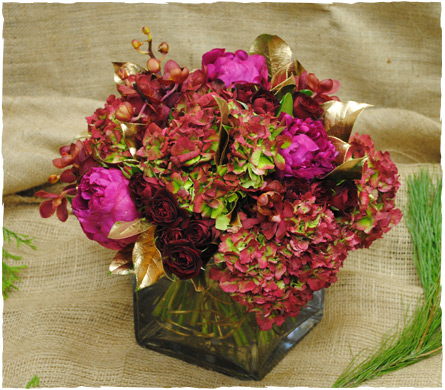
"Tis Flower Season" arrangement
“Tis Flower Season”

Hydrangea, peonies, roses, and orchids get extra dressed up with gilt leaves and golden colored wire. The ruffled texture and rich rosy shades are the type of holiday lush you want to bring home for dinner. The wine and gold coloring of this arrangement makes it suited for the season, without a holiday theme.

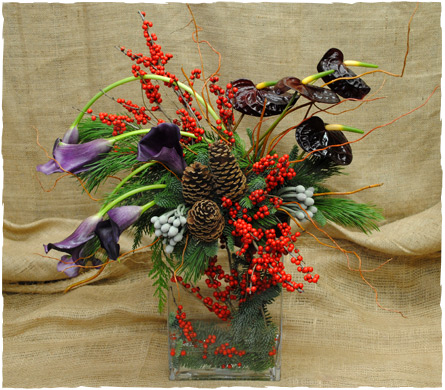
"Rockefeller Center" arrangement
“Rockefeller Center”

There’s nothing like New York during the Holidays and one of the best places to celebrate – Rockefeller Center. Whether you’re planning to visit for the tree lighting (Wednesday, December 3rd!), seeing the 41st annual Merry Tuba Christmas performance (Sunday, December 14th) or going to the Top Of The Rock Rockefeller Center will show you a great time. This arrangement with berries, calla lilies, anthurium, pinecones and winter greens echoes the hustle and excitement of one of our favorite centers of commerce here in NYC.

"Central Park" arrangement
“Central Park”

This dramatic piece echoes the natural beauty of Frederick Olmsted’s Central Park design. With the arrangement’s classic tribute to the holiday designs of yesteryear you can transform your space into a seasonal winter wonderland…without having to step outside!


Starbright Logo

Looking for flowers in New York City? Visit our Event Gallery for inspiration. Or see our daily selection at Starbrightnyc.com.

Seasonal Sophistication

Holiday Flowers
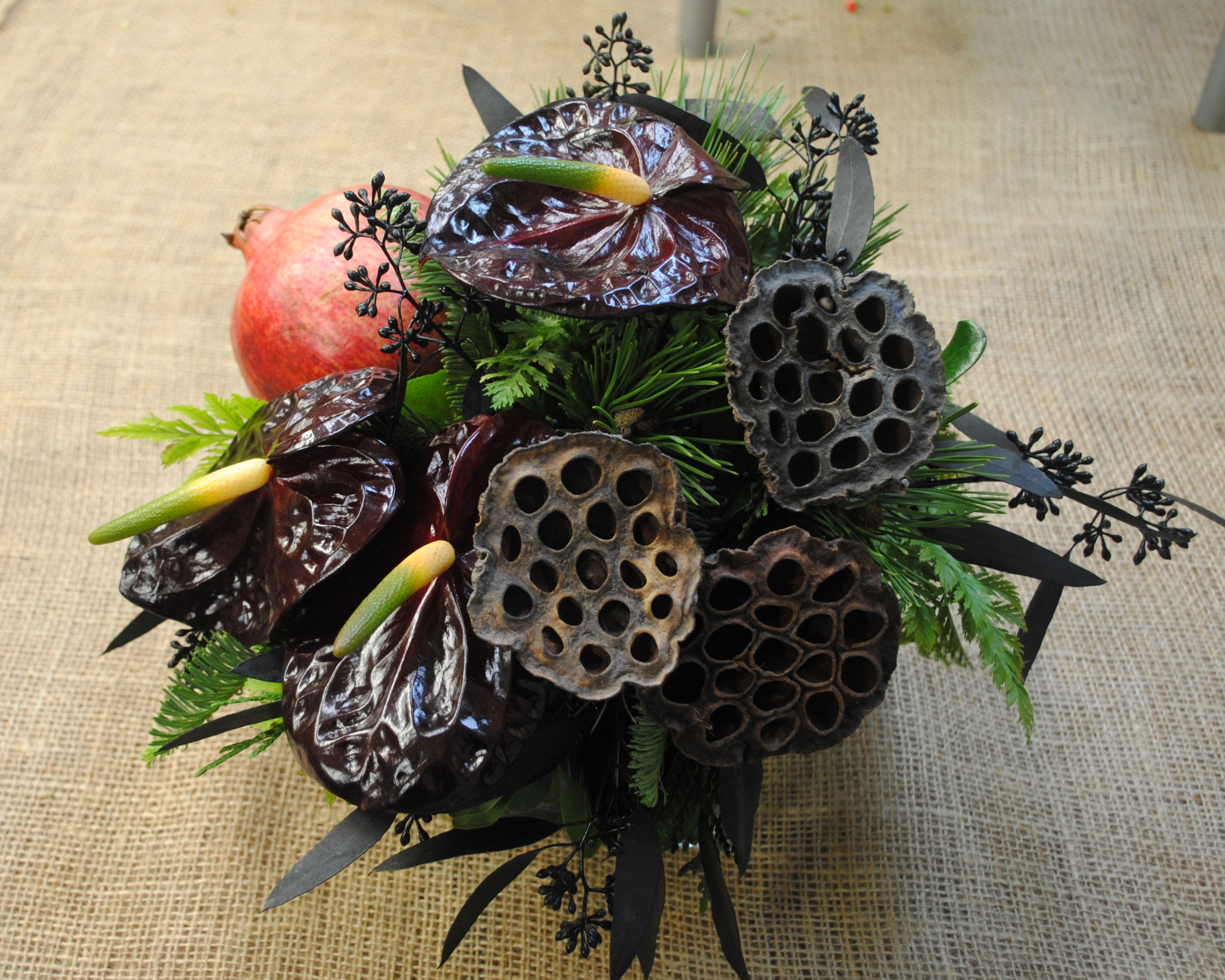
Lotus Pod, Anthurium, and Pomegranate

Here at Starbright Floral we love the earthy elements that characterize this time of year. We’re all about leaves, pinecones, sticks – the whole woods and the whole harvest. But when you’re planning an event that isn’t holiday related, beware of seasonal stereotypes.

Seasonal sophistication is about incorporating an aesthetic without sticking to the standards. Go ahead and look past the pinecones and pumpkins – they’re not going anywhere. The fall/winter season offers a host of alternatives to the traditional floral fare. 

A few of Starbright’s favorites this year include:

Lotus Pods : These seed pods are exceptional. The wood-like appearance and organic texture is unlike most formal elements. The pods, which grow alongside lotus flowers, begin small and as the seeds grow, the holes in the pod increase to accommodate them. We’re not saying that every flower has to have a meaning, but the idea of growing into each other strikes Starbright’s fancy.

Fruits and Nuts : Generally speaking, using edibles in floral arranging is pretty traditional unless you go for the exotic types. We love using pomegranates and citrus for the shots of color and a festive nature.

Of course, any floral variety can be dressed up to fit a seasonal occasion with supporting details. Some of Starbright Floral Design’s favorite seasonal floral supporters include :

Curly Willow : Wrap vases or integrate curly willow into the arrangement for a refined version of rustic that will fit a sophisticated style. The rich sienna color also echoes the warm tones of the season without being seasonal.

Sprayed Seeded Eucalyptus : Ok, ok – this one isn’t at all natural, but we love it anyway. Seeded eucalyptus has a delicate appearance, and is a great filler for large flowers that want a little something more than greenery. The natural silvery green color of eucalyptus can soften the overall appearance of an arrangement. Our favorite ways to dress up the seeded eucalyptus are in gold, silver, copper, and black.

Deep Colors : Starbright loves the warmth and drama of saturated hues. Many floral varieties are available in deep shades of red including the anthurium (in photo), roses, carnations, and calla lilies. Check out one of our modern favorites

Starbright Logo


Looking for flowers in New York City? Visit our Event Gallery for inspiration. Or see our daily selection at Starbrightnyc.com.

Flower Files: Brunia

Brunia
Brunia
Quick Notes /

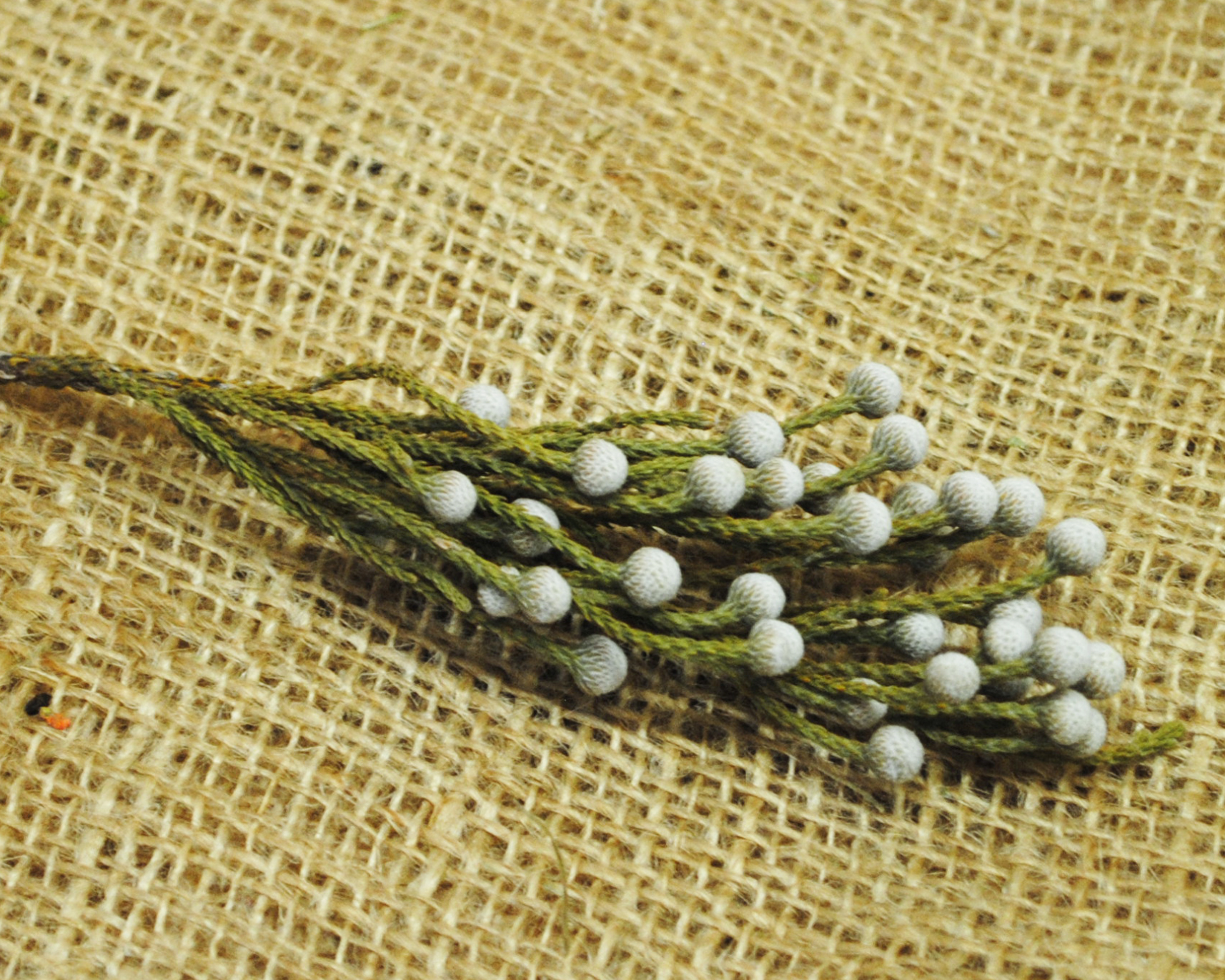
The Brunia flower is often overlooked in it’s natural habitat. The single-stemmed shrub it grows on vaguely resembles a pine tree, but is much softer, and grows between two and three meters tall. Brunia is characterized by small, spherical inflorescences that cluster at the end of a branch often disappear in the dark green foliage overhead.

As it is used in floral arranging, the petals of the Brunia flower have already fallen away to reveal a natural silvery cast that somehow seems both quirky and chic.


Flower History/

The Brunia albiflora is a tall shrub that is part of an ancient plant family. In northern Namaqualand, fossil pollen that matches modern Brunia pollen has been found in early Tertiary and late Cretaceous mineral deposits. If you’ve seen The Land Before Time…? This flower could’ve been Littlefoot’s lunch! But despite a very long history, this plant hasn’t spread very far, it’s native growth being isolated to southern tip of Africa.

“There is no indication where the ancestral stock originated, nor how it got to southern Africa. […] It could be that because this family is in a state of decline, its other relatives have already gone extinct and the southern African members are the only survivors.


But don’t worry that requesting this flower will contribute to it’s ultimate demise. Brunia flowers are commercially grown in Australia, California, or New Zealand.

As a decorative floral, Brunia is a fantastic filler! Because the flowers grow at the end of long branches, stem length is generally not a problem. These interesting florals last about a week, and will dry out nicely. Brunnia is most often available in silvery-white, but it also appears in yellow, green, and blush


Inside Info /
  • Brunia flowers are notoriously fickle about germinating. This is because the Brunia plant holds on to its dead flowerheads (which hold seeds) for up to 6 years! The seeds only drop and have the ability to sprout when a fire sweeps through and takes out the parent plant.
  • Sometimes used in the Language of Flowers for : Chivalry

Starbright Logo


Looking for flowers in New York City? Visit our Event Gallery for inspiration. Or see our daily selection at Starbrightnyc.com.
Saying Thanks with Flowers

“Visits always give pleasure–if not the arrival, the departure.”
Portuguese Proverb

Thanks

There’s lots of guides out there for our Holiday hosts and hostesses. We’ve been doing our research – there is a blog for everything. From cooking to cleaning, seating arrangements to after dinner activities for the kids…these guys have their work cut out for them.


To show our appreciation for all that hard work, and food, Starbright Floral decided to put some brain time into how to best show our appreciation with flowers.

Contained arrangements are great  host/hostess gifts, they allow for a quick pass-off and beauty...even days after you've gone!
Contained arrangements are great host/hostess gifts, they allow for a quick pass-off and beauty…even days after you’ve gone!

Saying Thanks with Flowers

The Problem : A bouquet looks best when unwrapped and ready to be admired. There’s nothing better than surprising a friend with flowers, seeing their face light up. But during the holiday’s, handing your host/hostess a handful of flowers, though sure to be appreciated, may cause inconvenience. 

The Solution : During the Holidays, it’s important to consider the timing and the recipient of your show of gratitude. Starbright Floral recommends these three alternatives that will surely go over with even the most harried host. 

Option 1 – Consider calling your host/hostess in advance of the party and voicing your interest in arranging flowers to show your gratitude. It is polite to inquire about preferred colors and a convenient time for delivery on the day of the party.

Option 2 – Arrive with an arrangement, unwrapped and in a vase. This is a great way to keep fuss time minimal for the recipient.

Option 3 – Sometimes the very best way to show your thanks is after the fact. Sending flowers the day after an event is perhaps the best way to treat the host/hostess. 

Tips and Tricks to getting it right.

1. Know your colors

Be aware of your host or hostess’s cultural traditions. Red and green arrangements are lovely, but they may get a funny look at a Chanukah party.  

2. Keep it odd

No, not the arrangement itself – the number of flowers. In the US, a dozen flowers, especially roses, will receive a warm welcome. But if your host/hostess is from elsewhere, an even number of flowers may be considered bad luck. For this reason, an odd number of flowers is generally considered best. Just avoid a bouquet of 13 flowers…many people all over the world consider 13 an unlucky number.

3. Be An Equal Opportunity Giver

Men and women alike appreciate flowers! No matter who is receiving the flowers, the trick to getting it right is to consider their personal tastes. If you’re giving flowers in advance of an occasion, consider their home and occasion theme. If you are sending flowers after the occasion, think about colors you’ve seen that person use. Is there phone case blue? Do they carry an orange wallet? These helpful details are useful guides for color selection.

Are you hosting Thanksgiving Dinner? Check out last weeks post for some ideas to Dress Up Your Table.

Starbright Logo


Looking for flowers in New York City? Visit our Event Gallery for inspiration. Or see our daily selection at Starbrightnyc.com.

The Starbright Team – Costas

Costas


We figured it was time to let you get to know some of the people who work in our office – operating the day to day activities in our client support, as well as making sure the flowers get where they’re going. Today, we’d like to introduce you to Costas:


How many years have you been working at Starbright? Can you mention something about when you started? 

My relationship with Starbright goes back in the late 1990’s, when the company was in its very early stages. There was a period of absence of some years and a reunification six years ago – we had such a good time arranging Carmine’s restaurant with Christmas décor.


What is your position at Starbright?

Operations Coordinator


What is your favorite advice to give an undecided client?

Leave it to our design team to produce a unique floral design appropriate for the occasion.


What’s your favorite flower? Color?

I like the Anemone flower. And I prefer the color orange when it’s an option – lucky for me, the anemone flower comes in lost of colors – including orange.


What’s your favorite floral style?

Balanced floral, modern or traditional.


Name one thing you love about working at Starbright. 

Action, we light up the place!


WOULD YOU RATHER…

Coffee or Tea?

Coffee

Go to the theater or a movie?

Theater


Sesame seeds or poppy seeds? 

Sesame


Thanks Costas!


It looks like the number of Starbright peeps on Team Sesame grows by one! What will happen next week? Only time will tell which team will bulk up as the shop staff and designers state their bagel preferences.

Starbright Logo


Looking for flowers in New York City? Visit our Event Gallery for inspiration. Or see our daily selection at Starbrightnyc.com.