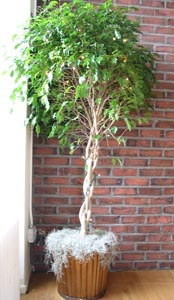
Ficus Trees: Moody but Gorgeous

Ficus Trees...
Take special care of your ficus and you will have years of enjoyment!

Ficus trees are perhaps the most popular indoor decorative trees grown.  The ficus benjamina – weeping fig – in particular is one of the most popular of the 800 species available. Their popularity is certainly not as a result of its easy care but rather, its beauty.  Ficus trees are very temperamental requiring constant vigilance in its care.  Ficus trees can become stressed by simple actions such as moving from one room to another or even from one end of a room to another.  Proper ficus tree care is essential to keep these plants healthy.  The ficus’ popularity, coupled with their temperament, was a motivating factor in launching Starbright’s exclusive Plant Care Maintenance Program.

Ficus Tree Care:

The ficus tree is a true creature of habit.  It does not like change.  Consistency is the key factor in its care.

Sunlight: Bright sunlight during the day, but should not be in full sun all day.

Temperature: The optimum temperature is between 65 and 75 degrees Fahrenheit.  Consistency is key-ficus trees should not place next to heaters or vents that create varied temperatures.

Watering: The soil should be kept moist but not wet, in a well draining pot to prevent root rot. The rule of the green thumb is to water after the top inch or two of soil has dried. Avoid overwatering your ficus! The most common mistake people make is to add more water once the leaves begin to turn yellow. This is the opposite of what you should do.

Humidity: Misting the tree frequently while it is young or adjusting to a new location, can help it maintain its humidity.  Helpful time saving hint is to make a humidity tray by filling the plant saucer with gravel.  The runoff water will evaporate through the plant, providing additional humidity.

Fertilizer: During growth periods, feed the plant every three to four weeks. Use a regular liquid fertilizer for indoor plants diluted to half the strength recommended on the package label. Decrease fertilizing in autumn and do not fertilize during the winter.

Trouble shooting leaf loss: Proper ficus tree care can help minimize leaf loss. Ficus trees commonly lose up to a quarter of its leaves after an environmental change. Diligent care can help mitigate additional stress. If leaves turn yellow just prior to dropping off, it is a sign of over-watering. Dull leaves may indicate a need for fertilizer.

These tips are brought to you by The Official Florist.  The Official Florist is the blogging arm of Starbright Floral Design.  We are a full-service corporate and retail florist located in the heart of New York City’s Historic Flower District.  We are at 150 West 28th Street (Studio 201).  To learn more about our organization and about the type of work that we do, please visit our website at www.starflor.com.

You may also order a gift by visiting our e-portal at www.starbrightnyc.com. Starbright is open seven days a week and we deliver flowers and other gifts in Manhattan and worldwide.  We invite you to give us a call or visit our website.

Thank you for visiting our blog.  Always “at your service”,

The Official Florist – Starbright Floral Design

“The Official Florist of the City that Never Sleeps”

t.800.520.8999

starflor.com

Bromeliad Plants: Matricide is Natural?

A Classic Bromeliad by Starbright
Aechmea fasciata
A Bromeliad Classic by Starbright
Guzmania Rana

Bromeliads are members of a plant family containing over 3000 species.  The most well known bromeliad is the pineapple.  People have been using bromeliads for thousands of years for food, shelter and ceremonies by civilizations such as Incas, Maya and Aztecs.  Europeans were introduced to the pineapple when Spanish conquistadors returned with the pineapple.  The image of the pineapple became so popular that it was adapted into European art, sculpture, furniture and architecture.

The most popular office and house plant varieties are Aechmea fasciata (Silver-Vase, Urn Plant) and Guzmania Rana.

In general they are ideal indoor plants requiring very little care.  The mother plant will generally only produce one bloom in its lifetime.  Once it blooms it will produce new plantlets called “pups”. These pups will feed on the “mother” plant until they are large enough to set roots of their own and survive as a separate plant. The mother has done her job and will die off.  The green, leafy top of a pineapple is in fact a pup that may be removed and planted to start a new plant.

It can take a few years for the plant to reach mature blooming size. Once the plant reaches maturity you can force the plant to flower by placing the plant in a clear plastic bag and throw a ripe apple inside the bag for 7 to 10 days. The ripe apple will give off ethylene gas and will help force the plant to flower.

1)      Sunlight: bright indirect sun.  Ideally placed around windows with blinds.

2)      Water: Keep the soil evenly moist.  Watering once to twice a week is sufficient. DO NOT USE A METAL WATERING CAN.  THE METAL IS TOXIC TO BROMELIADS AND WILL KILL THEM.

3)      Temperature: Indoor temperatures are perfect for Bromeliads.

Replanting the Pups: Once a pup reaches one-third the size of the mother plant gently tug and separate the two plants.  If the pup doesn’t pull away easily cut it where it attaches to the mother plant. Before potting your new plant, let the cut area dry out by letting it sit for a day (not in the sun). Using a mixture of peat moss and prelate pot up the bromeliad cutting into a small pot (do not over pot) and follow the instructions above. If all the potting and work sounds too much to handle ask Star bright about our Plant Care Services or do nothing and enjoy the plant as is.

These tips are brought to you by The Official Florist.  The Official Florist is the blogging arm of Starbright Floral Design.  We are a full-service corporate and retail florist located in the heart of New York City’s Historic Flower District.  We are at 150 West 28th Street (Studio 201).  To learn more about our organization and about the type of work that we do, please  visit our website at www.starflor.com.  You may also order a gift by visiting our e-portal at www.starbrightnyc.com. Starbright is open seven days a week and we deliver flowers and other gifts in Manhattan and worldwide.  We invite you to give us a call or visit our website.

Thank you for visiting our blog.  Always “at your service”,

The Official Florist – Starbright Floral Design

“The Official Florist of the City that Never Sleeps”

t.800.520.8999

starflor.com


The Chinese Money Tree: Luck be a Tree Tonight

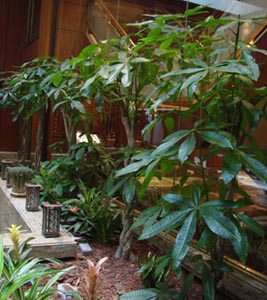
The Chinese money tree is a succulent ornamental houseplant that is said to bring luck to its recipient. Chinese money trees are aesthetically pleasing and low maintenance trees ideally suited for homes and offices.  Many people who decorate in the Feng Shui manner tend to incorporate this plant in their designs because of the five lobed leaves.  A Chinese money tree that has leaves in clusters of seven is considered especially lucky.  Another benefit of the plant for the busy office executive is that its leaves are edible.  No longer is time a reason to skip a meal.  Just reach over and grab a leaf!

Money Tree
NYC Money Trees-A Great Plant of All Seasons!

History

The Chinese have always believed strongly in the usefulness of lucky charms or symbols.  The Chinese Money tree is one of these symbols of luck.  Several stories tell the tale of origin of this tree’s symbolism.  One tale tells of a sculptor who placed fake money on a tree in order to trick villagers into cutting it down for him.   However, the tree was soon revered by the villagers as sacred.  It was believed that cutting it down would lead to their doom.  When the sculptor attempted to cut it down, the villagers paid him not to harm the tree.  Another story tells of an elderly man who gave a peasant a purported special seed.  The man told the farmer to plant the seed and water it daily with beads of his own sweat until it sprouted.  Once the seed sprouted the fledgling tree required drops of the farmer’s blood for survival.  The peasant did as he was instructed and the resulting plant grew up to be a “money tree”.  The peasant found that by shaking the tree, coins would fall to the ground.  Repeated harvests led to the peasant becoming rich.  The tree became a source of perpetual wealth.  The story can be taken literally.  However, today it is taken to mean that to become rich, it must be through hard work and one’s own sweat and blood.  The Money tree is a popular gift during the Chinese New Year.

Tree Care

1) Water:  Chinese money trees aren’t water hogs.  Typically they require a light watering once a week.  Feel the soil, if it is dry, time to water.  Do not spray mist.

2) Light: A young tree should not be subjected to direct sunlight.  Indirect sunlight for 4 hours a day is sufficient.  Mature plants can tolerate direct sun but prefer indirect.

3) Temperature: Chinese money tree grows well in typical indoor temperatures (60 to 85 degrees Fahrenheit).

4) Pruning:  Remove any damaged or dead leaves regularly thereby promoting new and healthy growth.

5) Fertilizer: Like any houseplant, a dose of fertilizer now on occasion is beneficial.  Be careful not to over fertilize.  Better to not fertilize rather than fertilize too much.

6) Repotting: The container of the money tree should not be undersized.  Typically every couple of years it’s time to repot the tree into a larger pot.  Make sure there are adequate drainage holes.  Inability to drain could lead to root rot.

This scribe is brought to you by Starbright Floral Design, “The Official Florist of the City that Never Sleeps”.  Along the way we try to find and write about the fun side of flowers.  Starbright delivers flowers all over the world for the endless romantics everywhere.

Starbright Floral Design is the “Official Florist of Romance” and most of the time we deliver flowers, love, passion and hope everywhere in Manhattan and worldwide.

Give us a call, visit our website or pop on in!  We would love to meet you….

Passionately yours,

The Official Florist

Starbright Floral Design

Located in the heart of New York City’s Historic Flower District

150 West 28th Street, Studio 201.

T. 800.520. 8999

Web: www. starflor.com

E-commerce portal: www.starbrightnyc.com

Amaryllis – Our Plant Care Series Continues

The Glorious Amaryllis
A bloom with ties to Greek Mythology...

Amaryllis-Beauty without the Beast of Burdensome Care

The Amaryllis, which features large, gorgeous trumpet-like flowers, is a popular gift come the wintertime.  Did you know the Greek mythological tale from which it gets its name?

Amaryllis was a shepherdess who loved a conceited shepherd. The shepherd, presumably a part-time botanist, said he would only love her if she created a flower.  Ingenuity being one of the many admirable qualities of Greeks, she stabbed herself in the heart in order to create a beautiful red blossom.

If you received an Amaryllis plant at any time this fall or winter,  its blooms have probably been open for a few weeks.  Generally they will bloom from 7-10 weeks.  To prolong the life of the bloom, keep the plant in a shaded cool room (65 F).   Keeping a blooming amaryllis in a bright room is not the best environment.  Sunlight and excessive warmth will cause the bloom to wither.  The plant loves moisture so keep the soil wet, but not over-watered.

With proper care, this gift is a gift that will keep on giving.  The bulb will flower again for years to come and each time it will bring a sense of excitement and accomplishment.  Regardless of the variety, from various shades of red, white, salmon, and pink, these flowers deserve the limited effort necessary to bring them back to bloom.  Of all flowering bulbs (tulips, hyacinth, etc), amaryllis is the easiest to bring to bloom over and over again.

After-Bloom Care

After the amaryllis has stopped flowering, unlike those box of chocolates, this gift can be brought back to enjoy again.  After flowering, cut the old flowers from the stem just in back of the bloom, removing the green ‘lump’ in back of the blossom, and the thin stem connecting the bloom to the main flower stem.  When the stem starts to sag and turn yellow, cut it back to the top of the bulb.

 
Continue to water and fertilize as with any plant all summer, or for at least 5-6 months, allowing the leaves to fully develop and grow. When the leaves begin to yellow, which normally occurs in the early fall, cut the leaves back to about 2 inches from the top of the bulb.

 
Put the potted amaryllis in a cool (55 degrees F), dimly-lit place such as a cellar for 6-8 weeks.   If storing in a refrigerator, do not store amaryllis with apples.  The apples give off ethylene gasses which will sterilize the bulbs and prevent future blooms.
After 6 weeks you should water the potted bulb ONCE thoroughly, from top and bottom of the pot and place in a normal indoor temperature.  Do not water regularly until new green growth appears at the top of the neck. If the soil dries out before that time, water no more than once per week.  Excessive watering will rot the bulb and prevent its bloom.   Typically the bulbs will re-bloom in 8 weeks.

Repeat these instructions and enjoy the amaryllis year after year…

These tips are brought to you by The Official Florist.  The Official Florist is the blogging arm of Starbright Floral Design.  We are a full-service corporate and retail florist located in the heart of New York City’s Historic Flower District.  We are at 150 West 28th Street (Studio 201).  To learn more about our organization and about the type of work that we do, please  visit our website at www.starflor.com.  You may also order a gift by visiting our e-portal at www.starbrightnyc.com. Starbright is open seven days a week and we deliver flowers and other gifts in Manhattan and worldwide.  We invite you to give us a call or visit our website.

Thank you for visiting our blog.  Always “at your service”,

The Official Florist – Starbright Floral Design

“The Official Florist of the City that Never Sleeps”

t.800.520.8999
starflor.com

For the Orchid Enthusiast…

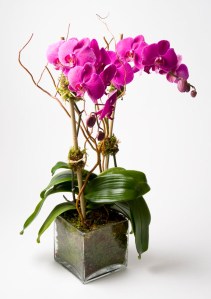
A double stemmed purple phaleonopsis orchid

Orchids give us so much majesty and beauty that they sometimes are intimidating and we feel that we cannot take proper care of them, or that we do not have a “green enough thumb” to be able to care for an orchid.  We shy away from the most majestic flowering plant simply because we do not feel competent or capable of caring for it.   Well for all the glory that orchids give, they do not ask for very much in return.  Here is a primer on orchids to help you over the initial fear…

FIRST – Come to Starbright (or any other reputable florist in your area) and purchase a Phaleonopsis orchid plant.  They come in a variety of colors but the most basic white or pink will do.  Remember that you are not buying this orchid as an expert or as a connoisseur, but rather as a novice trying to learn and to gain confidence that the plant can actually survive around YOU!

When you go home, place your orchid plant in a brightly lit room, but away from direct sunlight.  The orchid loves to bask in the sun but the more sun you give it the faster the blooms will open and eventually lose their petals.  You want a room that has sunlight but where the rays of the sun never hit directly on the plant.  Room temperature is fine.  In most cases if you are comfortable so is your plant.  This holds true for ANY plant (for the most part).   Also try to keep you plant away from sudden drafts.  A burst of cold air or hot air will certainly not help the orchid at all.

So far it is pretty simple, right?

Now make sure (at least for your first orchid) that you have a pot with good drainage.  Most orchids (phaleonopsis for certain) do not live in a swamp and if the water sits in the pot and does not drain, you are killing your plant.   So make sure that your pot allows excess moisture to escape.

Lastly – do not bother your plant.  The less you do for your orchid the more it will give back.  This is because there is not much that you can really do to care for the plant and in reality the plant requires very little care.  Water is about the only thing that it needs.

My advice to folks is instead of water; give your orchid ice cubes.  That is right – ICE CUBES.  Why?  Well for one, because when ice melts it becomes water.  It is a slow watering process because the ice melts slowly and it allows for the roots of the orchid to drink the water as opposed to the water running through the plant.  You also do not run the risk of the water ever building that swamp I mentioned earlier at the bottom of the pot.  So your orchid will get the water it needs and it will never be too much.  In most cases if the environment is not too hot or too dry, a handful of ice cubes a week will do.

Eventually the blooms on the plant will begin to wilt.  As they do, clip them off because they are unsightly.  As time goes on all the blooms will have opened and they will all have wilted. Eventually there will be nothing left but a bare stem.  Depending on what stage you had purchased your orchid in (how many blooms were open already, etc), this process should take no less than three weeks and in many cases an orchid will last over two months.

At the end of that period you should feel confident that orchids can in fact survive around you!  Hopefully you found enjoyment in caring for a live plant that gave beauty every day.  Now it is time to experiment!  No time to lose…

What do I do with that long stem that is bare and just sticking out of my pot?

Can I get my orchid to re-bloom?

What other orchid varieties are there?

What colors can I get?

Where do orchids come from?

There is a whole new world out there ready for you to explore!  It is a lot of fun and you can delve into it as much or as little as you want to.  Short of being a professional “orchidologist”, there are orchid clubs you can join, websites and books you can read from and there are even artists and photographers who have become known around the world simply because of their love for this magnificent plant.

You can go as far as you want to, or you can stay close to home.  Either way, it is a relaxing and enjoyable journey or hobby – depending on how you define it.

Here are two orchid websites that you should consider visiting:

The Orchid Board

American Orchid Society

I have found them to be informative and worthy of your interest.

Do you have a question? Send me a note at nic@starflor.com.  I will always be happy to hear from you and share some thoughts.  You can even visit our website (www.starflor.com) or call us at our store at 800-520-8999.  Reach out to us any way you would like to.  We will always be happy to hear from you and to help however we can.

A little bit about Starbright Floral Design – We are a full service florist located in the heart of New York City’s Historic Flower District (on 28th Street, between 6th and 7th Avenues).  We are open every day and most evenings till 8PM (Sunday until 6PM).  We deliver all over the world and can help you in selecting your gift to fit any taste design or budget.

Starbright was voted on Citysearch.com as the Best Florist of New York City in 2009.  We are the most reviewed and highest rated florist in New York.

TheKnot.com has also rated us as The Best Florist in New York City to partner with for wedding and bridal Florals.

We thank you for your support and look forward to hearing from you!

Find us on Facebook!