Flower File : Echinacea

Echinacea cone
Echinacea cone
Quick Notes :

Echinacea is part of the daisy family. This flower is unique to the areas of eastern and central North America, where you can find it growing in large numbers in open wooded areas and prairies.

Visual Notes :

Echinacea comes from the Greek word “echino,” meaning sea urchin, and the flower is certainly reminiscent of this spiny creature. The center of the flower is a spiky, cone-shaped disk, which leads its other nickname: the coneflower. The purple petals that surround the spiky center are removed before the flower is sold, because the petals are very delicate and bruise easily. Their absence makes the sea urchin-like center of this flower all the more striking.

Flower History :

Echinacea has been used in folk medicine for centuries. Native Americans originally observed this flower being eaten by elks that were sick or wounded. They adopted the flower for their own use in medicinal practices, and called it elk root. It was used to treat a variety of ailments, including sore throats, headaches, and the common cold. Native Americans passed on their knowledge of echinacea to Europeans, and the plant became popular in European medicine in the 1930’s. Feeling under the weather? Echinacea is still used today to boost the immune system. It’s great as a tea, but don’t try to boil anything from an arrangement – these guys have been drinking flower food which makes them unsafe as human food. 

Insider Information :

Echinacea is a great choice if you’re looking for an ornamental or decorative flowers, thanks to its unique appearance. You can find it in bloom from early to late summer. The cone will dry exactly as it looks and is great for decorating. 

Starbright Logo


Looking for flowers in New York City? Visit our Event Gallery for inspiration. Or see our daily selection at Starbrightnyc.com.

Flower File : Celosia

Paintbrush Celosia
Paintbrush Celosia


Quick Notes/

There are several types of celosia flowers, but this article will focus on the spicata variety. Celosias are resilient and will stay fresh for a long time after they are cut. They also make beautiful dried flowers, and are a popular choice for potpourri.

Visual Notes/

Celosia blooms in vibrant, citrus colors like pink, magenta, and violet. The flower grows in an elongated cone shape, similar to a wheat head, which is where it gets one of its several nicknames: the wheatstraw. It’s also commonly referred to as the paintbrush variety of celosia because of its shape. Its vibrant pink color has earned it yet another name: flamingo feather.

Flower Facts/

As celosias grow, their flowers bloom upwards and get taller. The petals near the top of the flower have bloomed most recently, while the petals near the bottom of the flower were the first to bloom. As the flowers grow larger, the vibrant pink color spreads upwards. The brightest colored petals can be found at the top of the flower, while the petals near the stem may lose their citrus shades and take on instead a silvery sheen.

Insider Information/

The name also comes from the Greek word “kelos,” which means burning, and describes the flame-like colors of the flowers. Silvery celosia takes color very well, and can be dyed a wide range of hues. Their strong stems make them especially resilient.


Starbright Logo


Looking for flowers in New York City? Visit our Event Gallery for inspiration. Or see our daily selection at Starbrightnyc.com.


Flower File : Clematis

Clematis
Clematis


Quick Notes /

Sometimes refereed to as Queen-of-the-vines, clematis is a member of the Ranunculaceae (buttercup) family. It can be found in most countries in the Northern Hemisphere. Clematis grows naturally as a climbing vine / lianasand has been harvested by many cultures for it’s medicinal values. But be careful! Clematis are toxic if eaten.


Visual Notes /

With over 250 cultivars grown around the world, the clematis flower is visually varied. All varieties feature a number of leafy petals clustered around the center of the flower. The colors range widely, but blue-purple, white and pink are especially popular.


History /

Because it’s found everywhere, Clematis is one of the first flowers early botanists and genetic researchers really took note of. As a result, it was widely used in early genetic experiments. Many of the British cultivars are the result of this early groundwork in understanding genetics.


Clematis
Clematis


Insider Info /

– The name Clematis comes from the Greek word “klematis,” meaning vine.

– Clematis are scented, but their scent is rarely strong enough for perfume making.

– A few clematis varieties change color when between blooming.  This is caused by environmental factors, like sunlight.


Starbright Logo


Looking for flowers in New York City? Visit our Event Gallery for inspiration. Or see our daily selection at Starbrightnyc.com.

A Hand Picked Romance

At Starbright Floral Design in New York City we’re inspired by the stories clients share with us. Roughly one out of every fifteen weddings we get to participate in decorating this season are for same-sex couples. Each one comes with a unique pair of individuals, with love in their eyes and a desire to give their family and friends an event to remember. We’re excited to share their experiences, and how those experiences have inspired us as we continue through the seasons.

As seen on The Edge, Boston 

Floral centerpieces
Centerpiece with late Summer garden flowers


A Hand-Picked Romance

“My partner and I have been dreaming about getting married for fifteen years. Being a same sex couple, I thought it would remain but a dream. When New York gave us the right to make it official we jumped at the chance. We booked a restaurant downtown for an intimate celebration with thirty or so friends. The floral designs were wildflower themed. I told Starbright I wanted it to look like I picked the flowers out of my garden. What they came up with from such limited direction was incredible. We got married in New York, with friends around us, with good food, surrounded by beautiful flowers. It was a dream come true. Starbright’s help in making this dream a reality can’t be overstated.”

– Shared by Jonathan V.

Jonathan and his partner’s earnestness inspired the Starbright team to craft arrangements that would imbue the atmosphere with the same sweet, everyday hopefulness that goes along with a bouquet of wildflowers.

Working With Wildflowers

Starbright-Flowers18

The trick to successfully using wildflowers for wedding decor is to know which varieties are in season. From early Spring to late Summer, new bloom varieties appear in the shop each week. Some of our favorites re-appear only briefly before they disappear again until next year. In Spring, blooms such as the lace-like aster, sweet smelling lilies of the valley, and the many petaled ranunculus are popular for weddings because they remind us of new beginnings and softer feelings. Late Summer wildflowers are a whole different ballgame. Be ready for bright colors, lots of texture and a trip to the wild side.

Late summer wildflowers tend to be wind-swept-and-wild. The colors, shapes, and textures are a great way to add a twist to standard floral fare. During this time of year, herbaceous florals begin to fill the Starbright Floral Design cooler; small, untraditional blooms stand out amongst twisted stems in shades of green. Great for adding dimension, texture, and scent, herbs first became popular in wedding arrangements during the Victorian era when they were used to also convey specific meanings. For the traditionalists, our favorite herbs to include are lavender for luck and devotion, rosemary to remember friends and family who cannot attend, and sage for a long life together. And for the bride or groom with stage fright, thyme or mint in the boutonnière is a must – the scents will help keep you calm and collected.

Unlike many popular wedding flowers, wildflower arrangements actually look better when they aren’t meant to be identical! The wild nature and shape of these flowers keeps them unified and also unique, just like the couple saying “I do.”

Today, weddings don’t have to mean what they used to. Mix it up! Define what’s right for you and then explore it. When it comes to the flowers, we’re here to help. From all of us at Starbright Floral Design, congratulations AND best wishes to all the happy couples!


Starbright Logo


Looking for flowers in New York City? Visit our Event Gallery for inspiration. Or see our daily selection at Starbrightnyc.com.
Flower File : Anthurium


Anthurium
Anthurium
Quick Notes /

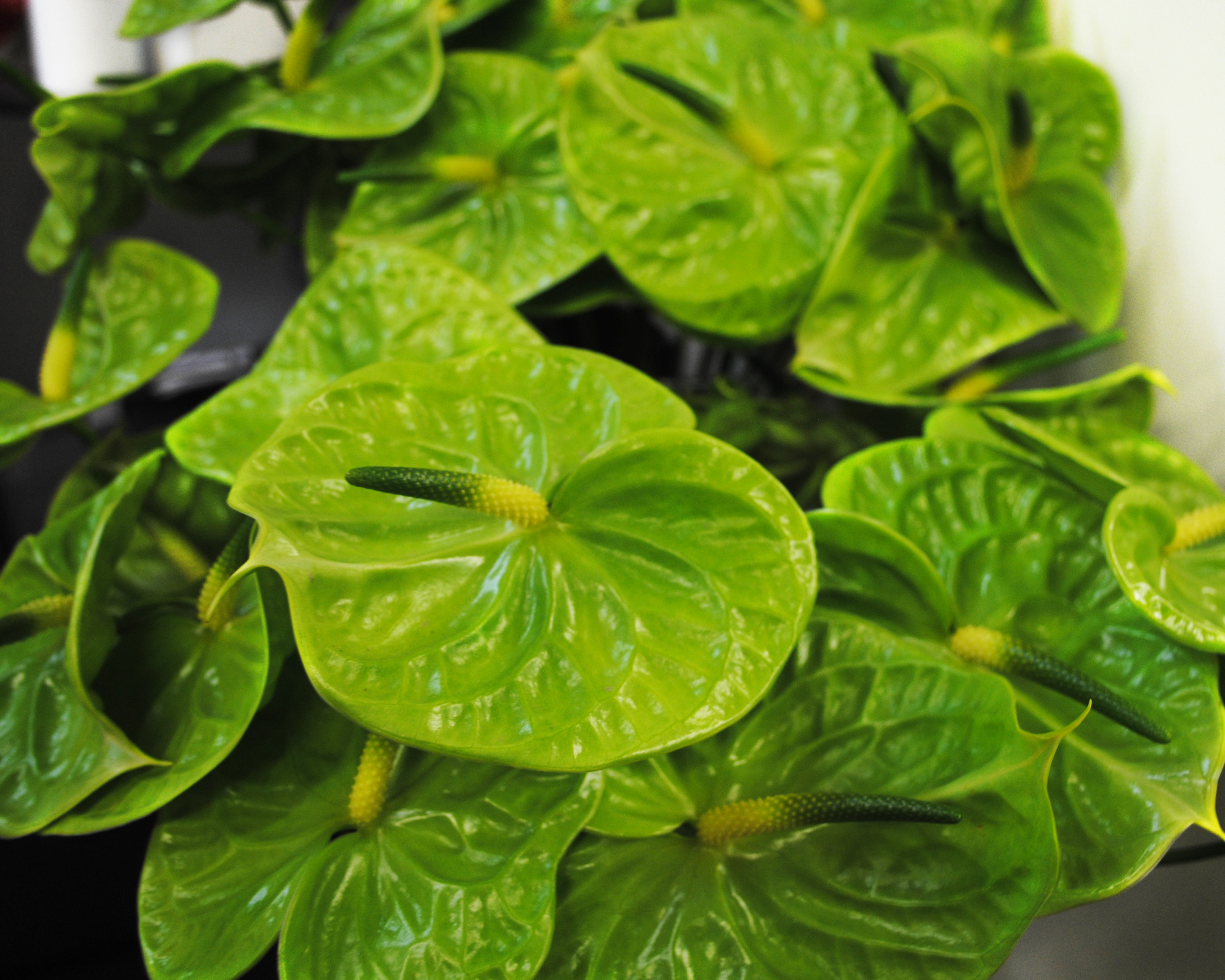
Technically an herb, Anthurium is found across Mexico, northern South America and the Caribbean. It features a tall, thin flower in the hip of a broad, flat leaf. Great for floral arrangements, anthurium will last a while.


Visual Notes /

Anthurium comes in a wide range of colors, across over 163 species. With anthurium, the sky’s the limit! Most typically, you’ll see the waxy leaves in green, white or red, with the flower usually being matching or yellow in color.


History /

In 1889, the first anthurium was brought to Hawaii from London. For over 120 years, the anthurium has been Hawaii’s most-exported decorative item – this includes beating sales of hula skirts, ukuleles and hula-ing bobble women.


Inside Info /

These are poisonous plants! Not a good call for environments with small children, pets or college kids experimenting with veganism.

Green Anthurium
Green Anthurium


Color Profile : Green

Ever wonder where flowers got their “meanings”?

Color psychologist don’t. And they have loads of studies backing up their theories. The general model of color psychology relies on six basic principles:

  1. Color can carry specific meaning.
  2. Color meaning is either based in learned meaning or biologically innate meaning.
  3. The perception of a color causes evaluation automatically by the person perceiving.
  4. The evaluation process forces color motivated behavior.
  5. Color usually exerts its influence automatically.
  6. Color meaning and effect has to do with context as well.[1]

Over at Starbright Floral Design, we get to work with lots of colors everyday and all of us have our favorites. But why are they our favorites and what does that say? Up this week, Marcela’s favorite :

Green

Green Anthurium
Green Anthurium

Green is the prime color of the world, and that from which its loveliness arises.” – Pedro Calderon de la Barca

What makes green so special?
Green is the easiest color for the eye to see and therefore considered balanced.  Environments are significantly enhanced by the presence of plenty of green.  On a primitive level, greenery reminds us of water and growth, and is associated by color psychologists with good-taste and a sense of security. Psysiologically, green helps balance emotions and creates a sense of calm. Consider a pair of green tinted shades – one study found that reading through a green tinted transparent sheet increased participants speed and comprehension!
For the Home
Give us a call to talk about bringing living greens into your space – we offer select seasonal varieties of . Green is a cool color and has a calming effect. Green is also a reassuring color. In the presence of greenery, people are subconsciously reminded of the presence of water – or the absence of famine.
Money Tree from Starbright Floral Design
Money Tree
For the Teacher

Starbright Floral Design’s succulent gardens are a low maintenance solution for a busy teacher. And worth your while as well! A study at The Royal College of Agriculture in Circencester, England, found that students demonstrate 70 percent greater attentiveness when they’re taught in rooms containing plants. The same study reported that classrooms with plants reported higher attendance than those without plants.  This effect carried over into a study that showed that students were more likely to join and continue to participate in after school programs and activities that took place outdoors or had greenery present.

The Greenhouse from Starbright Floral Design NYC
The Greenhouse


For the office

What works for students works for me.  Green plants in an office space promote concentration and perspective.  And why stop at plants? Starbright Floral Design also offers a number of green floral arrangements to satisfy a person’s need for green.

Take Me To The River

Starbright Logo   Looking for flowers in New York City? Visit our Event Gallery for inspiration. Or see our daily selection at Starbrightnyc.com.

Color Profile : Yellow

Ever wonder where flowers got their “meanings”?

Color psychologist don’t. And they have loads of studies backing up their theories.

The general model of color psychology relies on six basic principles:

  1. Color can carry specific meaning.
  2. Color meaning is either based in learned meaning or biologically innate meaning.
  3. The perception of a color causes evaluation automatically by the person perceiving.
  4. The evaluation process forces color motivated behavior.
  5. Color usually exerts its influence automatically.
  6. Color meaning and effect has to do with context as well.[1]

Over at Starbright Floral Design, we get to work with lots of colors everyday and all of us have our favorites. But why are they our favorites and what does that say? First color up for consideration, the king of the color psychology world:

Yellow

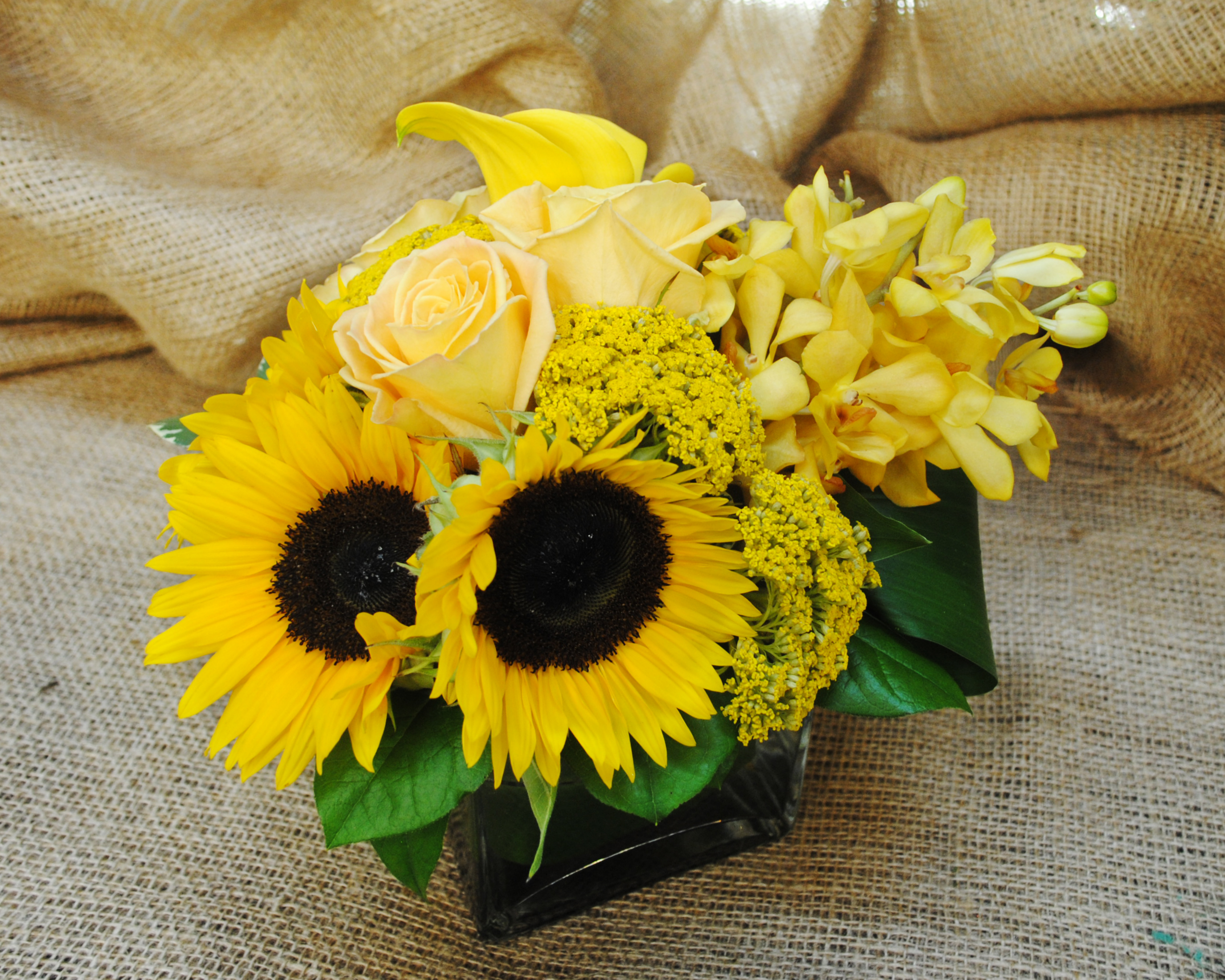
Starbright floral design yellowHow wonderful yellow is. It stands for the sun. -Vincent Van Gogh

Yellow is most often associated with happiness and competence. Due to the amount of light that is reflected, yellow is the most visible color of the spectrum. Because it is so easy to see, yellow is more attention-getting than other colors. It also stimulates stronger reactions in people than most other colors.

Starbright Floral Designs in Yellow


To an office

A little yellow in an office goes a long way.  Physiologically, yellow stimulates mental activity.  It can help to increase the speed of analytical processes and logical reasoning.


To support and encourage

A bouquet of yellow flowers can increase the recipients energy, confidence, and happiness level. Bright yellows also relate an optimistic outlook, while pale yellows may be better for also communicating sympathy.


To congratulate

Help aim the spotlight and say “well done!” with an arrangement that calls attention to the recipient.


Starbright Logo


Looking for flowers in New York City? Visit our Event Gallery for inspiration. Or see our daily selection at Starbrightnyc.com.


Protea

Pincushion Protea
Pincushion Protea


QUICK NOTES /
With a wide variety of styles and typically larger bud sizes, a protea bouquet is a dynamic choice for situations that want a bold floral statement.
According to the language of flowers, proteas symbolize diversity and courage.
VISUAL NOTES /
With over 1,400 cultivated varieties, there’s quite a bit of variance among members of the protea family. There are three dominant petal shapes – feathery spikes, leafy spades, and more stiff colored scallops. Buds come in a wide variety of colors, as well, with individual petals often showing color gradation. Overall, protea tends to be large enough to act as the focal point of an arrangement.
FLOWER HISTORY /
Named by the famed botanist Carl Linnaeus in 1735 for Proteus, a Greek water god who could change it’s form at will, to allude to the dizzying array of shapes the plant comes in. Native to southern and eastern Africa, protea are among the only flowers who’s nectar was used as a sweetener. The Boers of South Africa called sweeteners made from protea nectar bossiestroop, which was more-or-less rainwater and plant nectar drained from the flower into a bucket, cooked down into a syrup, and used to sweeten tea.
INSIDE INFO /
Pincushion protea are an especially interesting plant – the long spiky petals have enough structure that they are able to serve as creative placecard holders or picture frames.

A bouquet En Plein-Air

Karl Albert Buehr - The Parasol
Karl Albert Buehr – The Parasol

Karl Albert Beuher was one of the early Chicago painters to adopt Impressionism. He joined other American artists in Giverny, France, to paint en plein-air in the commune established by Claude Monet. These impressionists developed a style that required quickness in order to finish a piece before the sun moved and the light changed. They wanted to capture their subjects, which were generally natural scenes, as the eye might see them. Instead of hard lines and lots of detail, Bueher’s brush delivered bursts of color and light that seem to illustrate a fleeting moment in time. He wants us to see ripples in the leaves instead of the angles in the bark. He wants us to see a sea of long grasses and field flowers instead of individual blades of grass and carefully represented blooms.

The art of floral arrangement is as varied as any art form. Last week, we showed you our Georgia O’Keefe inspired arrangements and how color and line can be used to suggest energy and emotions. This week we’re looking at another bouquet – this one designed on the same principles as Bueher’s  early works.

Wedding bouquets

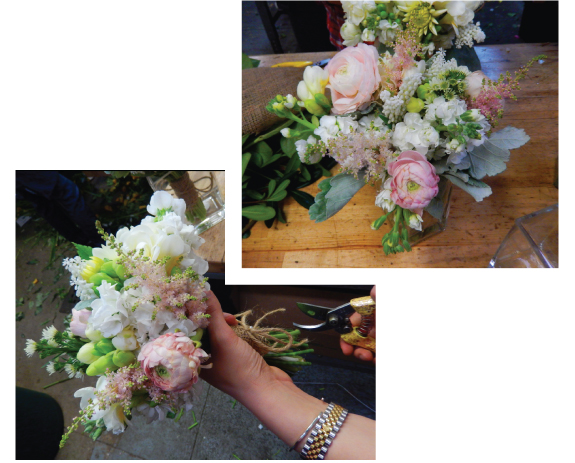
We’re focusing on the impression of these flowers as a whole, instead of on any one individual “wow” flower.  There is a lightness represented in Beuher’s work that we wanted to capture. In regards to the design above, we wanted to create something genuine, unfettered, and at one with the scene. Something that would be memorable for the occasion, but serve to enhance the impression of the overall, rather than draw attention to itself.

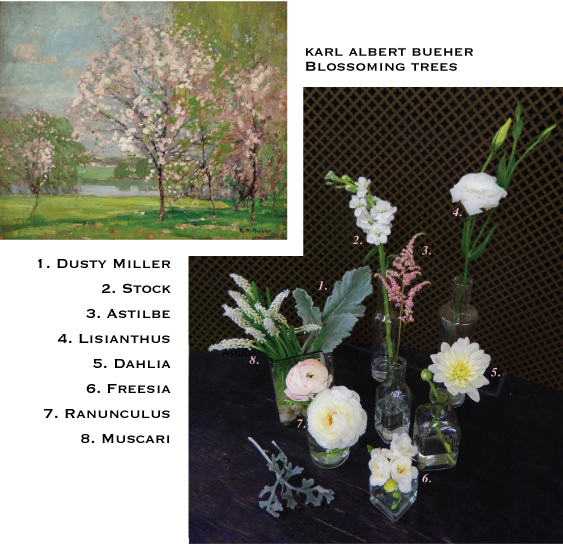
Take a look at Beuher’s painting below and the flowers we selected to make up this arrangement. For our “plein-air” bouquet, we want to create a light and feathery texture similar to that of Beuher’s brush strokes. The vibrance of the colors in the artwork are also important. We love how shadows are created with vibrant shades of green and the pink – they create contrast we might describe as “lightness” instead of “brightness”.


Flowers used in bouquet


Each flower was carefully selected for it’s size, color, and texture. Our wind-swept bouquet of wildflowers is purely fantastical – few of these flowers are native to any one common region. Luckily, here at Starbright, we had no problem getting the flowers we wanted. Our selection included :
1/ Dusty Miller – The quaint name isn’t the only thing we love about this hardy foliage. With it’s silver-white color and soft texture, this leaf adds a wistful element to any arrangement.
2/ Stock – Noted for it’s heady, clove-like scent. This example of the variety, with double flowers, adds texture to our arrangement. Stock also is a symbol of a happy life and a contented existence.
3/ Astilbe – These remind us of wildflowers. The feathery stalks seem to float in this arrangement.
4/ Lisianthus – Native to equatorial areas of the American continents. This delicate, long-lasting, prairie flower has ruffled petals. They represent warmth and geniality.
5/ Dahlia – Sometimes called the “Queen of the Autumn Garden”, the dahlia belongs to the Asteraceae family which is noted for their star-shaped blooms and includes flowers lie the daisy and sunflower. Traditionally these flowers symbolize hope for an everlasting union.
6/ Freesia – Sweetly, citrus-scented and long-lasting, these graceful flowers are perfect for a bouquet. Each wiry stem can have up to 10 flowers.
7/ Ranunculus – The fine layers of petals give this weighty flower a delicate appearance.
8/ Muscari – Small and fragrant, the shape of these flowers is reminiscent of little bells.


Starbright Logo


Looking for flowers in New York City? Visit our Event Gallery for inspiration. Or see our daily selection at Starbrightnyc.com.
Georgia O’Keeffe and a Colorful Bouquet

Georia O'Keeffe inspired bouquet


Georgia O’Keeffe was inspired by what she saw in nature – over here at Starbright, we’re inspired by her perception and the images she shared.

The painting above is Ms. O’Keeffe’s Music, Pink and Blue No. 2. This abstract expression of music has an informal balance that gently flows across the canvas to create a soothing rhythm. The pattern, created by repeating circular lines and colors creates the impression of layers. Even the color harmonies mimic music.  The deep pools of concentrated color create a base (or bass!) for the sweeping mid-values to stand out against. The orange and white splashes, which are only partially visible in the above image, add focus – like lyrics, they sit slightly towards the foreground of the painting and give the eye something to pivot around.

Armed with inspiration, it’s easy to interpret O’Keeffe’s interpretation back into the natural.  The medium – flowers.

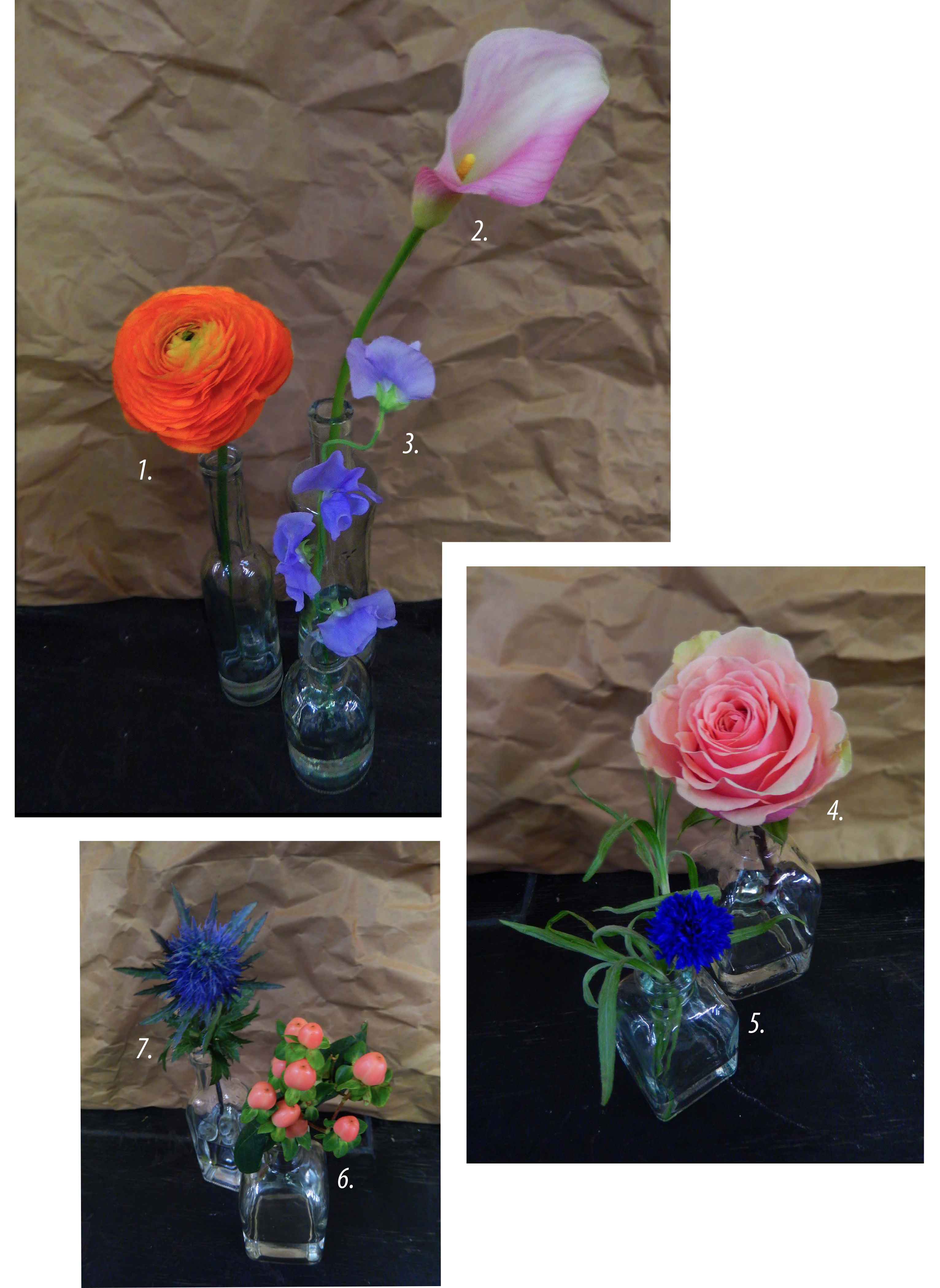
The bouquet in the above image was composed of the following flowers:


flowers

1/ Ranunculus : These bright orange flowers have crepe-paper thin petals. We’re reminded of the layered feel of the pattern in Music. The bright color is creating bright points of focus in these arrangements. Ranunculus come in a brilliant variety of colors. Giving a ranunculus says “I am dazzled by your charms”.

2/ Calla Lily : These undeniably elegant flowers mimic the central shape in Music. The washed pink color also reminds us of the calming shades of pink in the painting. These flowers represent abundance and beauty. 

3/ Sweet Pea : These richly colored, sweet-smelling flowers come in a variety of colors and represent blissful pleasure. The flowers themselves are about one inch big and resemble butterflies with folded wings. We chose a purple shade.

4/ Rose : This rose variety has a color gradation effect in its petals – the outer petals are light pink and get darker near the center.  According to The Language of Flowers, a pink rose represents perfect happiness. 

5/ Cornflower : These brilliant blue flowers are often called bachelor’s buttons.  The name comes from an old folk tradition that claims if worn by a young man in love the flower can divine the feelings of his beloved.  Because of this tradition, the cornflower has come to represent hope in love.  We’re going to use these in the groom’s boutonniere. 

6/ Hypericum Berries : These smooth peach colored berries add another texture to our arrangement.  We especially like how clean they look against all the ruffled petals. 

7/ Thistle : Ok, these are a little out there for the inspiration, but the rich blue/purple color and spiky prickles add great color and texture.  The thistle is also a Scottish symbol of noble character – which we think is pretty fitting for a wedding.  

The inspiration can be seen throughout the bridal parties pieces.  Below is the groom’s and groomsmen’s boutonnieres.

Georgia O'Keefe inspired Boutineers

We had a lot of fun making these colorful pieces!

Congratulations and best wishes to the happy couple!


Starbright Logo

Starbright Floral Design began as a husband and wife team who had a passion for hard work and floral artistry.  Over twenty years later, we continue to stand by these founding principles. Looking for flowers in New York City? visit our Event Gallery for inspiration. Or see our daily selection at Starbrightnyc.com