A popular floral symbol of the Christmas Season, Pointsettias are indigenous to Mexico and Central America. The poinsettia plant generally grows to be between two feet and thirteen feet tall. The common English name – poinsettia – comes from the last name of Joel Roberts Poinsett, the first United States Minister to Mexico. Mr. Poinsett introduced the plant to the US in 1825.
Poinsettia Visual Notes /
The large dark green dentate leaves grow lower on the stem than the colored bracts, which are often mistaken for petals. The colored bracts are available in white, cream, pale green, pink, orange, marbled, or the most popular – bright red. The color of the bracts is affected by photoperiodism. Photoperiodism is a physiological reaction caused by the length of daylight or night. Poinsettias are peculiar in that their bracts require at least twelve hours of darkness in order to change color, but also exposure to bright light to deepen the shade of the color. The flowers of the poinsettia are tiny and unassuming. Their yellow structures cluster in the center of the leaves.
Poinsettia
Poinsettia Flower History/
The poinsettia has been called many things over the years and around the globe. The original name for the poinsettia plant is Cuetlaxochitl, which is Nahuatl for “flower that grows in residues or soil”. The ancient Aztec used the Cuetlaxochitl bracts for their red dye and as a medicine. In Mexico, the poinsettia is called flor de noche buena or “Christmas Eve flower” while in some other Spanish speaking countries it is called flor de pascua or “Easter flower”. In Egypt, the name Bent El Consul translates as “the consul’s daughter” – in honor of Mr. Poinsett.
In the US, the poinsettia was popularized by the Ecke family in California who first sold poinsettia plants at street stands during the Holiday Season. After three generations of cultivating the plants, Paul Ecke Jr. solidified the plants Holiday association by sending free poinsettia plants to television stations from Thanksgiving to Christmas to be displayed on the air.
Poinsettia Inside Info /
Keep your poinsettia healthy by following these pointers
Water the soil when it begins to dry (aim for moist, but not soggy).
Keep the plant away from hot or cold drafts (a general temperature of 60-70 degrees fahrenheit is best)
Expose the plant to natural light
Despite popular belief, the Poinsettia is not poisonous – it’s been cleared of all charges by the American Medical Association.
Poinsettia plants will change color year after year with a little bit of work. Beginning in October, stash your plants in total darkness from 5pm to 7am and then expose them to full sun. Repeat every day and in eight to ten weeks, your poinsettia bracts should be changing color.
Looking for flowers in New York City? Visit our Event Gallery for inspiration. Or see our daily selection at Starbrightnyc.com.
Also called Rose Hep or Rose Haw, these are the pollinated fruit of a rose plant, which begins developing in Spring and look like large bright berries by Autumn. They are generally available in a reds and oranges, but some varieties of roses have darker almost purple or black rose hips. A few species of roses are grown for the aesthetic value of their hips instead of their blooms, including Rosa movesii, which has large, bright red fruits. The waxy skin of the rose hip is reflective and seems to glow among the greenery in an arrangement.
Flower History/
Rose hips have a long history. While the rose hips we use are only for looking at (we do not recommend picking any of these fruits out a floral arrangement) these fruits have been used in everything from herbal teas to the central ingredient in the national soft-drink of Slovenia. There is rose hip jam, itching powder, and even wine and bread. This versatile fruit has one of the highest levels of vitamin C available in a plant. The rose hip Wikipedia page offered this fun historical fact :
During World War II, the people of Britain were encouraged through letters to The Times newspaper, articles in theBritish Medical Journal, and pamphlets produced by Claire Loewenfeld, a dietitian working for Great Ormond Street Hospital for Sick Children, to gather wild-grown rose hips to make a vitamin C syrup for children.
Inside Info /
Most rose species require that the hip be chilled in order to germinate – some species only germinating after two winter chills have occurred.
The hairs inside the rose hip fruit are highly irritating.
The wild Dog Rose is most often cultivated for it’s hips.
Looking for flowers in New York City? Visit our Event Gallery for inspiration. Or see our daily selection at Starbrightnyc.com.
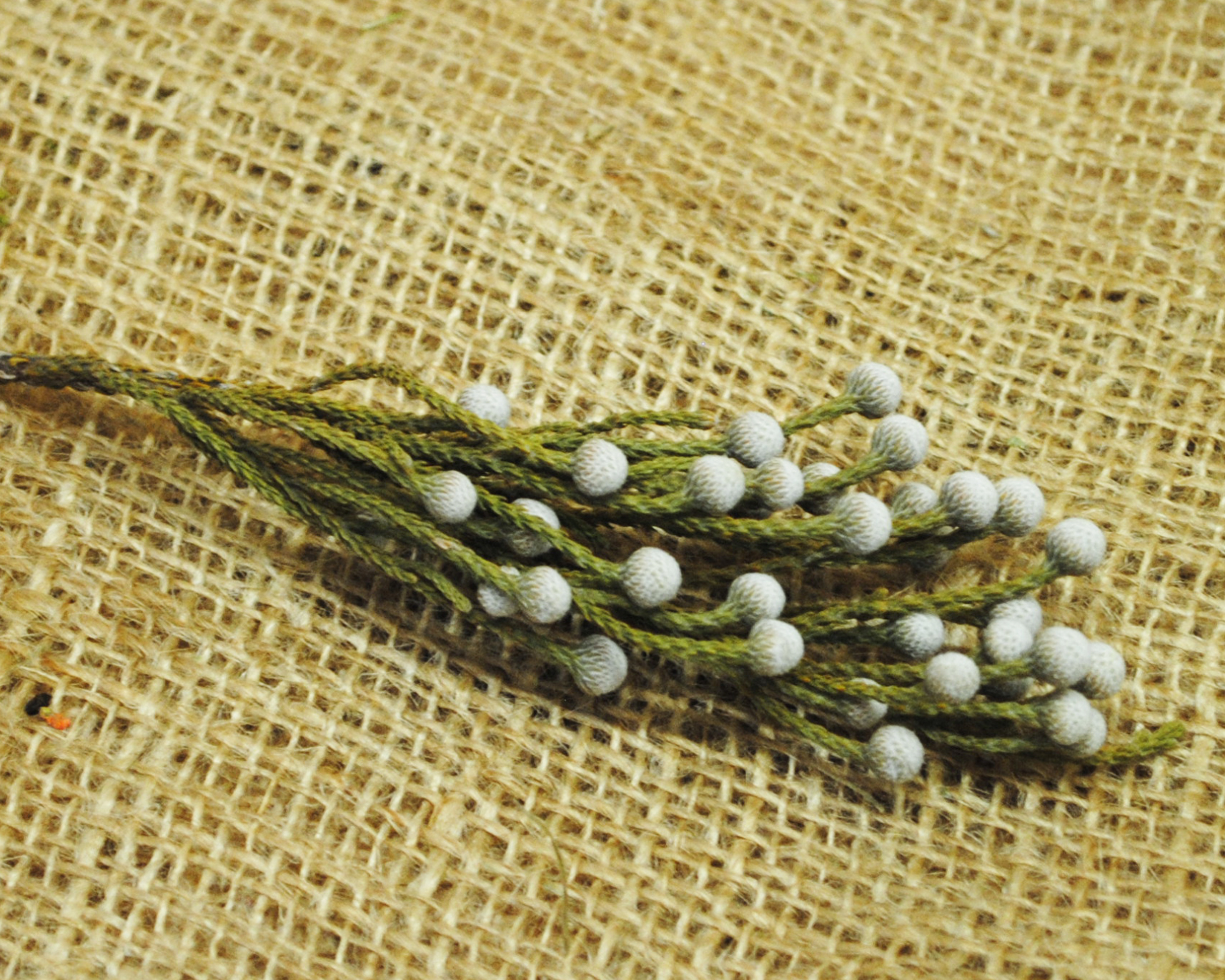
The Brunia flower is often overlooked in it’s natural habitat. The single-stemmed shrub it grows on vaguely resembles a pine tree, but is much softer, and grows between two and three meters tall. Brunia is characterized by small, spherical inflorescences that cluster at the end of a branch often disappear in the dark green foliage overhead.
As it is used in floral arranging, the petals of the Brunia flower have already fallen away to reveal a natural silvery cast that somehow seems both quirky and chic.
Flower History/
The Brunia albiflora is a tall shrub that is part of an ancient plant family. In northern Namaqualand, fossil pollen that matches modern Brunia pollen has been found in early Tertiary and late Cretaceous mineral deposits. If you’ve seen The Land Before Time…? This flower could’ve been Littlefoot’s lunch! But despite a very long history, this plant hasn’t spread very far, it’s native growth being isolated to southern tip of Africa.
“There is no indication where the ancestral stock originated, nor how it got to southern Africa. […] It could be that because this family is in a state of decline, its other relatives have already gone extinct and the southern African members are the only survivors.
But don’t worry that requesting this flower will contribute to it’s ultimate demise. Brunia flowers are commercially grown in Australia, California, or New Zealand.
As a decorative floral, Brunia is a fantastic filler! Because the flowers grow at the end of long branches, stem length is generally not a problem. These interesting florals last about a week, and will dry out nicely. Brunnia is most often available in silvery-white, but it also appears in yellow, green, and blush
Inside Info /
Brunia flowers are notoriously fickle about germinating. This is because the Brunia plant holds on to its dead flowerheads (which hold seeds) for up to 6 years! The seeds only drop and have the ability to sprout when a fire sweeps through and takes out the parent plant.
Sometimes used in the Language of Flowers for : Chivalry
Looking for flowers in New York City? Visit our Event Gallery for inspiration. Or see our daily selection at Starbrightnyc.com.
Well, that’s it, it’s over – those long days of summer are gone. Even though our days are getting shorter and it’s almost always dark by the time we get home, here at Starbright, we’re finding lots of ways to brighten things up. Autumn flowers are winding down, but some of our very favorite staple flowers are at their peak: alstroemeria, carnations, lilies, and roses and most importantly – the flower of the month – the chrysanthemum.
The name “chrysanthemum” is derived from the Greek words chrysos (gold) and anthemon (flower). Don’t let its name fool you into thinking these guys are only available in the beautiful yellow/orange combo that is so common at this time. There are about 40 different species of chrysanthemums and countless varieties and cultivars that are available in a wide variety of colors, shapes, and sizes. Because of this overwhelming diversity, chrysanthemum plants are further described as being either a “garden hardy” or an “exhibition” variety and the bloom types can be further described as belong to one of the thirteen bloom forms recognized by the US National Chrysanthemum Society, Inc., which follows the international classification system.
According to principles of Feng Shui, Chrysanthemums are the floral representation of the Fall season and are ideal for brightening up a space. According to this practice, the cheerful presence of these blooms excites happiness and laughter. During the Fall season, displaying chrysanthemums creates especially good luck.
Here are five Feng Shui ways to use chrysanthemums to brighten up our days as they keep getting shorter!
The showy, yellow, round-headed chrysanthemums are perhaps the most sought after due to their symbolic association with a life of ease.
White and Yellow chrysanthemums are great for energizing “metal” spaces of the home which are associated with children, creativity, and helpful people.
Chrysanthemums encourage tranquility and help to alleviate of grief and anxiety.
Wish someone a long life and much contentment with a bouquet of chrysanthemums.
Living chrysanthemum plants acts as indoors air filter, are easy to care for, and last will bloom for much longer than cut flowers – while having all the same symbolic perks of the cut flowers. Ask about Starbright’s Plant Boutique!
Color meaning is either based in learned meaning or biologically innate meaning.
The perception of a color causes evaluation automatically by the person perceiving.
The evaluation process forces color motivated behavior.
Color usually exerts its influence automatically.
Color meaning and effect has to do with context as well.[1]
Over at Starbright Floral Design, we get to work with lots of colors everyday and all of us have our favorites. But why are they our favorites and what does that say? Up this week :
Orange
Orange comes in all sorts of forms here at Starbright Floral Design
“Orange is red brought nearer to humanity by yellow.” Wassily Kandinsky
The color orange has a special place in Starbright’s design palette even though it is the most contested colors here in the US; people generally have a “love it” or “hate it” reaction to orange. Here at Starbright, we tend to collectively lean towards loving it. And what’s not to love? According to Color Wheel Pro, “Orange represents enthusiasm, fascination, happiness, creativity, determination, attraction, success, encouragement, and stimulation”.
What makes orange so special?
Orange is a vibrant and energetic color that is highly visible to the human eye. It is often used catch attention and highlight important elements of a design. For a similar reason, orange can also be considered a “bargain” color – in floral design, this means orange flowers will make an arrangement feel more present.
The shade of the color is extra important when considering the symbolic associations of orange. Because the color was named for the fruit, orange is often associated with health and vitality. While in a muted tone, burnt or greyed oranges that can be commonly spotted in the color of changing leaves are most often associated with Autumn. Because of the close connection to nature, more subtle shades of orange are often used to represent change, movement, and comfort.
For Encouragement
Orange you glad you did something for yourself today?
Are you trying to start a new project? Quit an old habit? Beginning a journey? Orange promotes a positive perspective on life and help to motivate people to look on the bright side of a situation. According to the color symbolism of ancient heraldry, orange represents strength and determination.
Looking for something for someone young? Kids and teens are especially down with the color orange. We’re guessing it might because orange tends to carry a sense of adventure about it.
It’s not always easy to say what you want to say. The color orange is associated with social communication. Studies have shown an increase in two-way conversations while the color orange is present. According to color theorists, “this color is both physically and mentally stimulating which gets people thinking and talking!”
Looking for flowers in New York City? Visit our Event Gallery for inspiration. Or see our daily selection at Starbrightnyc.com.
We figured it was time to get to know some of the fine folk who work in our office – operating the day to day activities in our client support, as well as making sure the flowers get where they’re going. Today, we’d like to introduce you to Mariana:
How many years have you been working at Starbright? Can you mention something about when you started?
I’m actually coming up on a year in a few months! I started at Starbright this past Valentine’s Day and it was probably one of the most overwhelming things I’ve ever been a part of. Valentine’s Day is so amazingly busy for us, that I just had to dive right in and get comfortable in the office pretty quickly.
What is you position at Starbright?
Well, my official title is “Client Success Advocate”, so I will do just about anything that needs to be done to make sure an order is fulfilled to the best of our abilities – whether it be taking pictures of an arrangement or running out to get a cake, I’ll do it! I also take orders over the phone and work closely with Stephen and Nic with whatever they need.
What’s your favorite flower? color?
My favorite color is blue, but when it comes to flowers it would have to be purple or pink. One of my all-time favorite flowers is purple stock – it always contributes something sweet and simple to an arrangement.
What’s your favorite floral style?
My favorite floral style would probably be romantic and modern mixed together. I really like the shapes that we create when an order calls for something modern. And you can never go wrong with something romantic!
Name one thing you love about working at Starbright.
The environment, definitely. Everybody in the store gets along and we know how to have a laugh during a stressful time, and then get back to work when we need to. I know if I ever have a bad day, someone in the office will be able to cheer me up.
What languages do you speak?
I speak English, Spanish and a lick of Greek. My Spanish is pretty good, since I lived in Chile for a year and my mom is a native speaker. I can say cake in Greek, which let’s face it, is really the only word you need to know.
WOULD YOU RATHER…
Wear a sweater or sweatshirt?
Can’t go wrong with a big, comfy sweater!
Go to the theater or a movie?
Movie, definitely. Biiig movie geeks in my family.
Sesame seeds or poppy seeds?
Neither!
Thanks Mariana!
Looking for flowers in New York City? Visit our Event Gallery for inspiration. Or see our daily selection at Starbrightnyc.com.
When it comes to boutonnières, this is a pretty common question. Put your worries to rest, Starbright Floral Design will always include pins…whether or not you decide to use them.
At one point, every suit lapel was made with the expectation of wearing a boutonnière. If you happen to have a vintage suit in your closet, take a peek at the underside of the left lapel. You may find a flat loop about one inch below that buttonless buttonhole. This detail made it easy for a man of elegance to slip the stem of a boutonnière flower through the hole and under the loop so that it stayed secure, sans pins. While the extra buttonhole persists as a menswear standard, the boutonnière loop, unfortunately, seems to have faded into the past. Many suits today are designed without the boutonnière loop or an open buttonhole. Not to worry! This is a situation that either your tailor or you, and some YouTube tutorials, can solve in no time.
But don’t feel pressured to try your hand at tailoring in the days leading up to your big event! Boutonnière flowers today are commonly reserved for special occasions; while a single bloom used to be common, now boutonnières generally include at least three or more flowers, some type of greenery, as well as decorative ribbon for stem wrapping. With all that going on, it is not only perfectly acceptable, but also more common, to wear your boutonnière pinned to the outside of your lapel. About the only thing affected by the pins will be your suit.
If the boutonnière wants to be pinned to the jacket let the buttonhole placement guide you. Depending on the size of your arrangement, the bottom of the blooms in your boutonnière should be level with, or not too far below, the extra buttonhole on your left lapel. The tips of the flowers shouldn’t go above the seam where the collar and lapel meet, nor should they be below the extra buttonhole.Basically, if you’ve covered the extra buttonhole – you’re good.
Boutonnières from Starbright Floral Design
Starbright’s designer, Patti Ann, put together three examples of light weight designs that may be worn pinned or tucked through the hole and loop.
1. Mini Dahlia, Thistle, and Seeded Eucalyptus:
The dahlia and thistle in this boutonnière represent strength and grace.
2. Mini Calla Lily, Seeded Eucalyptus, and Dusty Miller:
Know you’ve picked The One? The calla lily symbolizes deep wisdom and intuition.
3. Ranunculus, Brunia, and Seeded Eucalyptus:
And by selecting a boutonnière with ranunculus, you’ll be representing everlasting commitment and devotion.
Would you like more info about boutonnières?
The Gentleman’s Gazette has provided a couple comprehensive articles full of the history, how-to, and general encouragement of the gentlemen’s boutonnière.
Looking for flowers in New York City? Visit our Event Gallery for inspiration. Or see our daily selection at Starbrightnyc.com.
We figured it was time to let you get to know some of the people who work in our office – operating the day to day activities in our client support, as well as making sure the flowers get where they’re going. Today, we’d like to introduce you to Abe:
“It’s the team spirit that makes it so great to be here”, says Abe, a seven year veteran of the Starbright Floral office team. But we think it might have something to do with the samples as well – Abe has exceptional taste (pun intended), and is responsible for our Gourmet Corner. On the phones, Abe offers years of flower knowledge. He prefers to get to know the recipient by getting to know their taste, rather than what their favorite flower might be – “I find it’s all about who the person is, and getting to know that person through the customer.” His favorite flower is the white calla lily, which he finds lends itself well to Modern arrangements. He speaks Arabic and a little French.
WOULD YOU RATHER…
Go to the theater or a movie?
Abe would rather attend the theatre.
Pop or Soda?
No matter what it’s called, Abe, doesn’t drink either. He’ll take the Vodka Martini straight up with olives please.
Thanks Abe!
Looking for flowers in New York City? Visit our Event Gallery for inspiration. Or see our daily selection at Starbrightnyc.com.
New York City might be a Concrete Jungle, but that doesn’t mean that it’s not also a great place to catch some fall foliage. We’re in the thick of October, which means that the next three weekends are going to be among the best of the year for viewing fantastic local color. This week’s blog is a collection of great places to catch some great trees without leaving New York City limits.
Without further ado, here’s our breakdown for Brooklyn, Queens and Manhattan:
QUEENS:
1 – Alley Pond Park’s “Yellow Trail” – Alley Pond is an interesting park. It sits more-or-less in a glacial moraine, which is a land formation composed of many mixed materials left behind by the glaciers that created Long Island and Manhattan. As a result, Alley Pond Park has a highly diverse ecosystem, with a whole bunch of trees. There are mostly hardwoods, oak and hickory. Alley Pond also boasts a public high-ropes course!
2 – Astoria Park – The color here is offset by the mixed-blues and greys backdrop of ocean, sky and Manhattan Skyline. While you’re here, you might as well get some great Greek food at Stamatis on 23rd Avenue or BBQ at Strand Smokehouse on Broadway.
MANHATTAN:
1 – The West Village – There are a ton of trees here. Every block looks like a movie set for “old timey New Yawk,” if you can ignore the fro-yo shops. What’s cool about a West Village foliage walk is that you can also do some shopping, stop at Magnolia Cupcakes, or expand your world percussion collection at the same time.
2 – Central Park – But you knew that, you’re a smart cookie. I mean, there’s over 23,000 trees there, which is an average of over 1,000 per acre. Anywhere you go, it’s going to be great.
BROOKLYN:
1 – Prospect Park – The same rules as Central Park apply – there are a ton of trees here, and it’s beautiful everywhere.
2 – Ocean Parkway – If you’ve got a car, try heading for a ride down Ocean Parkway, from the Prospect Expressway down to Coney Island. It’s tree-lined the whole way down, and passes through a wide range of neighborhoods. The drive is a real slice of old-skool New York City, taking you through the real Brooklyn.
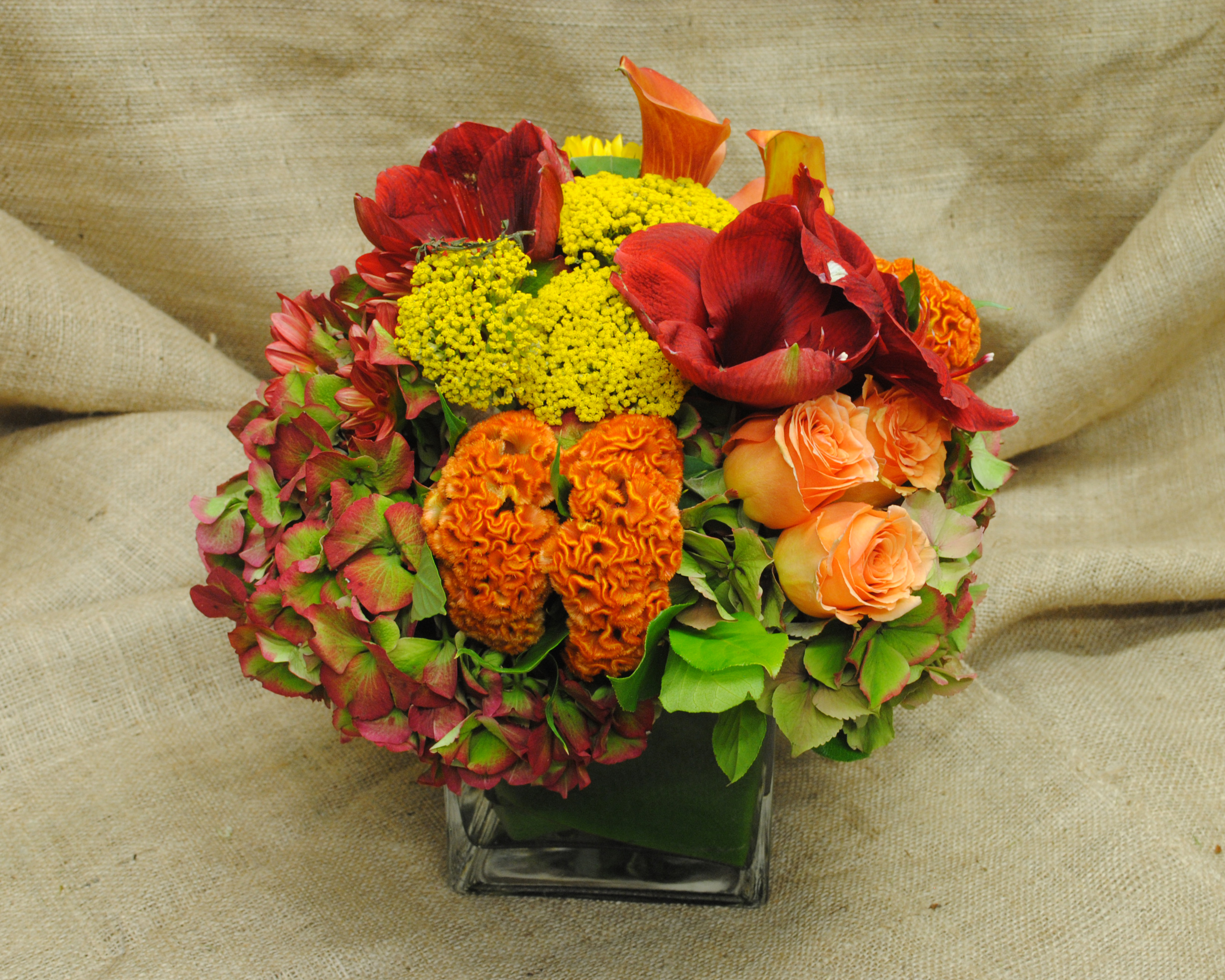
And if you can’t make it outside – don’t forget that Starbright Floral Design is happy to bring the season to you. We’re featuring a ton of autumnal arrangements with colored leaves, fall foods, and seasonal weeds (the pretty sort).
Apples are showing up everywhere!
And because we can’t help our seasonal joy – today we’re sharing a special New York style apple pie recipe from the Starbright team! Happy Fall!
BIG APPLE PIE
In New York, sometimes there just isn’t room for kitchen equipment – it’s a cold hard fact that can really cramp one’s cooking style. This recipe comes from one our team, who first learned how to make this recipe entirely by hand! She’s since then added a food processor to the process, both methods are listed below.
PIE CRUST :
2 1/2 cups flour (the general sort)
1 tsp salt
1 tsp sugar
1 cup of butter (still cold! cut into small cubes)
1/3 cup water (ice cold)
1. Combine flour, salt and sugar in a bowl – give it a couple gentle stirs to mix.
2. Add the butter – mix the butter and dry combination until combined and looking like course meal.
By Hand : Use a wooden or metal spoon to sort of mash the butter into the dry mix repeatedly against the side of the bowl, while turning the bowl for the best leverage – cold butter can be uncooperative. Be careful to not overdue it though, the goal is to keep the butter cold throughout this process. Chasing just the big lumps of butter into only the very dry floury leftovers will help. And get ready, this hand process won’t be quick
By Food Processor : Add your dry ingredients to the mixing bowl and pulse for 2 seconds to combine. Next, add the butter, and pulse again until the mixture looks like course meal – about 8 seconds.
3. Add ice cold water.
By Hand : Add about half of the water and combine gently. Add more water slowly until the dough holds together. The goal is to get all the dough to hold together with the least amount of water.
By Food Processor : Add the water in a steady stream through the processor’s tube until the dough just holds together. Do not process for more than 20 seconds to combine the water.
4. Turn out the dough onto a surface and divide into two roughly the same size balls. Press the dough flat (by hand). Wrap the flattened balls in plastic wrap and store in the fridge for at least an hour.
FILLING :
Preheat the oven to 450 degrees.
1 lemon, squeezed – about 2 tbsp juice
8 apples (your choice!)
1/2 cup sugar
1/4 brown sugar
1 tsp ground cinnamon
1/2 tsp salt
1. Peel and cut apples into slices or wedges that are about 1/4″ thick. Toss with lemon juice to prevent browning.
2. Combine remain ingredients in a bowl and mix until apples are fully coated with sugar.
PUT THE PIE TOGETHER
2tbsp butter (cut into small cubes)
1. Roll out one of the flattened dough balls and lay it into a buttered pie plate to form the outside crust. Let any over hanging dough stay there for a minute.
2. Add the pie filling to the crust. It’ll look like there’s too much – pile the filling mound higher at the center.
3. Press the butter cubes into the filling – spaced out.
4. Rollout the second dough ball on a floured surface. This will be for the top of the pie. Wet the edge of the bottom of the pie crust and lay the top on evenly. The wetted edge will help them stick together. Look up some decorative designs if you’d like to make yours unique!
5. Make sure the pie crust has a vent. If the crust is left solid, it will probably break and ooze apple filling…A lesson learned after one memorable mess. Cutting 4 or 5 slits in the top crust should do the trick.
BAKE IT!
1. When the oven is at 450 degrees, slip in the pie. Bake for 20 minutes.
2. Reduce the heat to 375 degrees and continue baking until the pie looks done. “Looking done” requires about 45-60 more minutes and a golden-brown crust.
3. If you don’t want to globby mess, allow the pie to cool completely before serving. It’ll take about 5-6 hours.
ENJOY!
Looking for flowers in New York City? Visit our Event Gallery for inspiration. Or see our daily selection at Starbrightnyc.com.
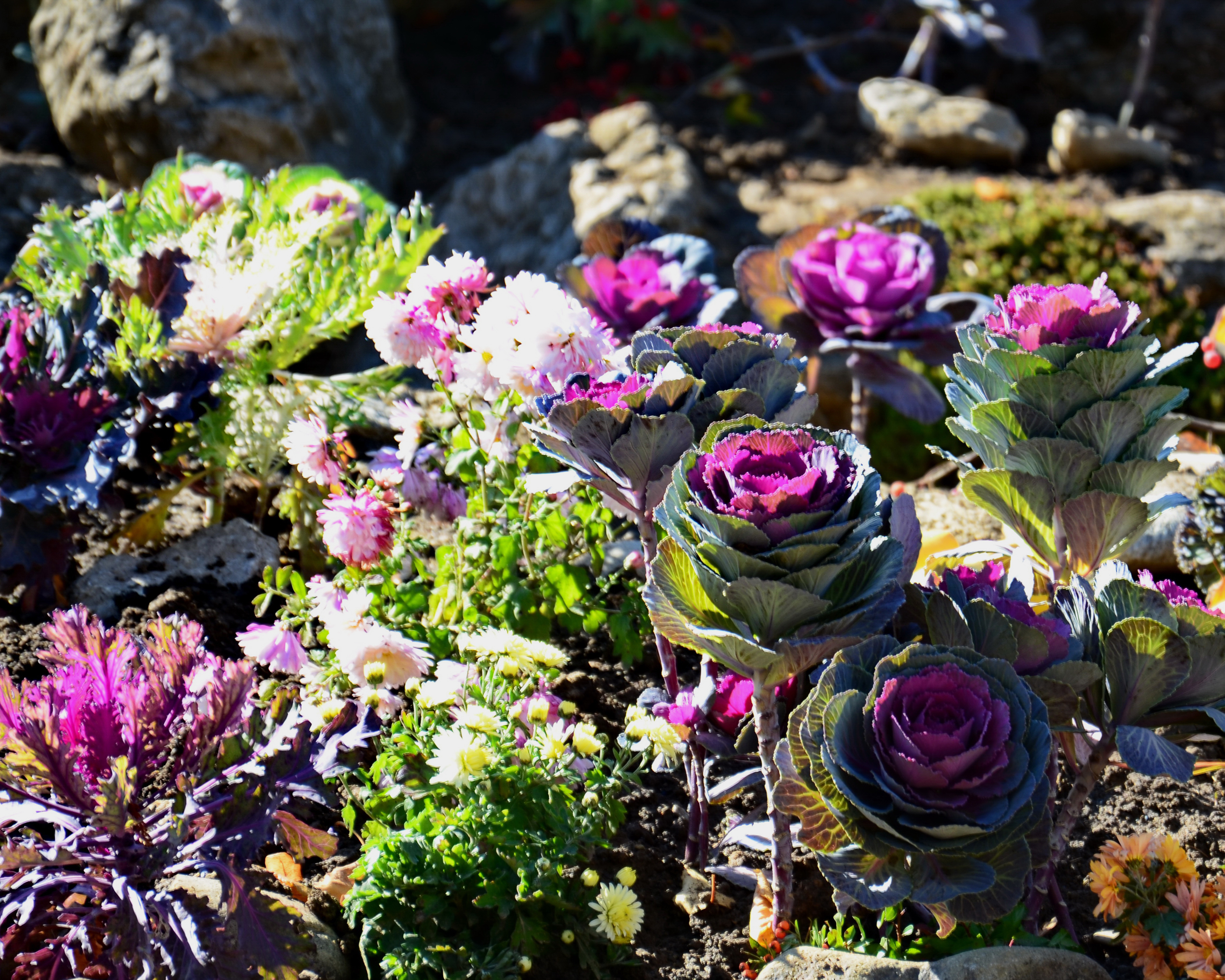
Cabbage, and yes, we’re talking about the vegetable here, is a great addition for an autumn arrangement. No, but seriously, despite their less than exotic origins, Cabbages have layers of leaves that overlap in a spiral pattern from the center of its head. The leaves can be either smooth or ruffled, open and large or tightly furled and resembling a rose. The alternating leaves can be lobed or wavy and even highly vained. There are varieties that feature a waxy coating on the leaves. And all of those great attributes come in a variety of colors. From the clean and classic white and green cabbage to the fancy purples and reds there’s a cabbage for all occasions. And while the cabbage plant grows really sweet, little yellow flowers, we don’t bother with them in arrangements. The big, bold, and hyper textural cabbage heads are far more our style.
Flower History/
Native to Britain and continental Europe, today’s cabbage were developed as a crop way back in before 1000 BC. As a food staple, cabbage made its way around the classical world and was greeted with either great devotion or great antipathy. Great people including Cato the Elder and Diogenes considered cabbage superior to all other vegetables. In Europe, cabbage found great popularity during the High Middle Ages, when other crops were in short supply. From Europe the crop spread to Mesopotamia to Egypt as a winter crop and from there it followed the trade routes and continued to spread. There isn’t a lot of evidence that the colorful crop was used in a decorative manner, but here at Starbright, we can imagine that the purples and greens that last well after most flowers drop, have always been a sight for tired eyes. It isn’t a surprise that at some point, someone started cutting the smaller heads for filling vases.
Inside Info /
Babe Ruth used to place a cabbage leaf under his hat before each game.
The world’s largest cabbage was grown in 1865 in Durham, England by William Collingwood – it weighed in at a whooping 123 pounds!
At one time, Russian princes paid tribute not only with racing horses and jewels, but also with potted cabbage plants.









 Blooming Thoughts
