NYC Plant Files: Lemon Tree

Lemon Tree
Lemon Tree
Lemon Tree Notes /

Lemon trees are a vibrant addition for any NYC home that has a bit of extra room. These small evergreens grow to be about three to five feet tall and will keep their color year-round. A number of popular indoor varieties will bear fruit with some regularity after they have matured (lemon trees take three or more years to mature when grown from a seed!). Starbright Floral likes to recommend the Eureka variety because it regularly produces flowers and fruit year-round. Meyer lemons are another popular variety, though they are actually a cross between a lemon and either an orange or a mandarin. Meyer lemons bear a slightly sweeter lemon-alternative primarily in fall and winter. If fully grown, these fruit factories can produce up to six hundred pounds of lemons a year! To thrive, lemon tree need lots of light and a draft-free life. They’re worth the effort. Some studies show that the smell of lemon helps enhance mood. Read more about plants and feng shui here or how smell can effect a mood here, or even this about how the color green can help revitalize your energy.

Lemon Tree History/

Lemon Trees are thought to have first grown in Assam, Burma, and China and may actually be a cross between a bitter orange and a citron. By 900CE, lemon trees had spread throughout most of the known world. Used for medicine, cleaning, cooking, and decorating, lemon was an important crop for the Mediterranean. For early sailors, including Christopher Columbus, lemon was crucial to preventing scurvy. When the early european ships sailed to the New World, lemon seeds went along for the ride.

Lemon Tree Inside Info /
  • Bright yellow lemons are ripe and ready to be eaten, while lemons with a little bit of green may continue to ripen on the tree or be picked and stored until they are a uniform yellow.
  • Lemons are toxic to cats and dogs; it will upset their stomachs and moods.
  • The heaviest lemon ever grown was recorded in Kefar Zeitim, Israel. It weighed 5.265 kg (11 lb 9.7 oz), had a circumference of 74 cm (29 in) and was 35 cm (13.7 in) high. Guinness World Records 2013.


Starbright Logo


Looking for flowers in New York City? Visit our Event Gallery for inspiration. Or see our daily selection at Starbrightnyc.com.

NYC Flower Files: Ornithogalum

Ornithogalum
Ornithogalum arabicum
Ornithogalum Notes /

NYC flower shops love this unique bloom. The designer’s at Starbright are no exception.  To see an example of a NYC Flower arrangement containing Ornithogalum see herein. These readily available blooms are a favored addition to Starbright’s weekly flowers in NYC program for their extra long vase-life.   There are four common varieties of of ornithogalum that tend to show up in cut flower arrangements. The difference between these blooms is primarily in the shape of the flowering head. Conical and drooping or round like a button, most ornithogalum blooms have delicate white petals and a striking black center; the exception is ornithogalum dubium whose petals range from yellow to bright orange. Ornithogalum is native to Africa and Eurasia, but it’s long bloom-time and sweet smell have made it a garden favorite worldwide. However, with the help of pollinating bees, some of these garden varieties have crossed their fences and become invasive species.

Ornithogalum Flower Meaning/

Ornithogalum arabicum is often referred to as star of Bethlehem or Arabian star flower. Because of this biblical association, many people prefer this blossom for it’s symbolic representation of purity, hope, and happiness. Ideal for a romantic bouquet, ornithogalum is favorite of old-time romantics.

Ornithogalum Inside Info /
  • Some varieties of ornithogalum can be toxic if ingested and others may cause skin irritation if handled for prolonged periods of time. Be careful of this lovely bloom around children and animals.
  • Popular names for ornithogalum include Star of Bethlehem, Nap at Noon, Snowdrop, Arabian Star Flower,  Eleven-o’clock Lady, Sleepydick, Arabian Star Flowers.

Starbright Logo


Looking for flowers in New York City? Visit our Event Gallery for inspiration. Or see our daily selection at Starbrightnyc.com.
NYC Flower Files: Delphinium

Delphinium
Delphinium
Delphinium Notes /

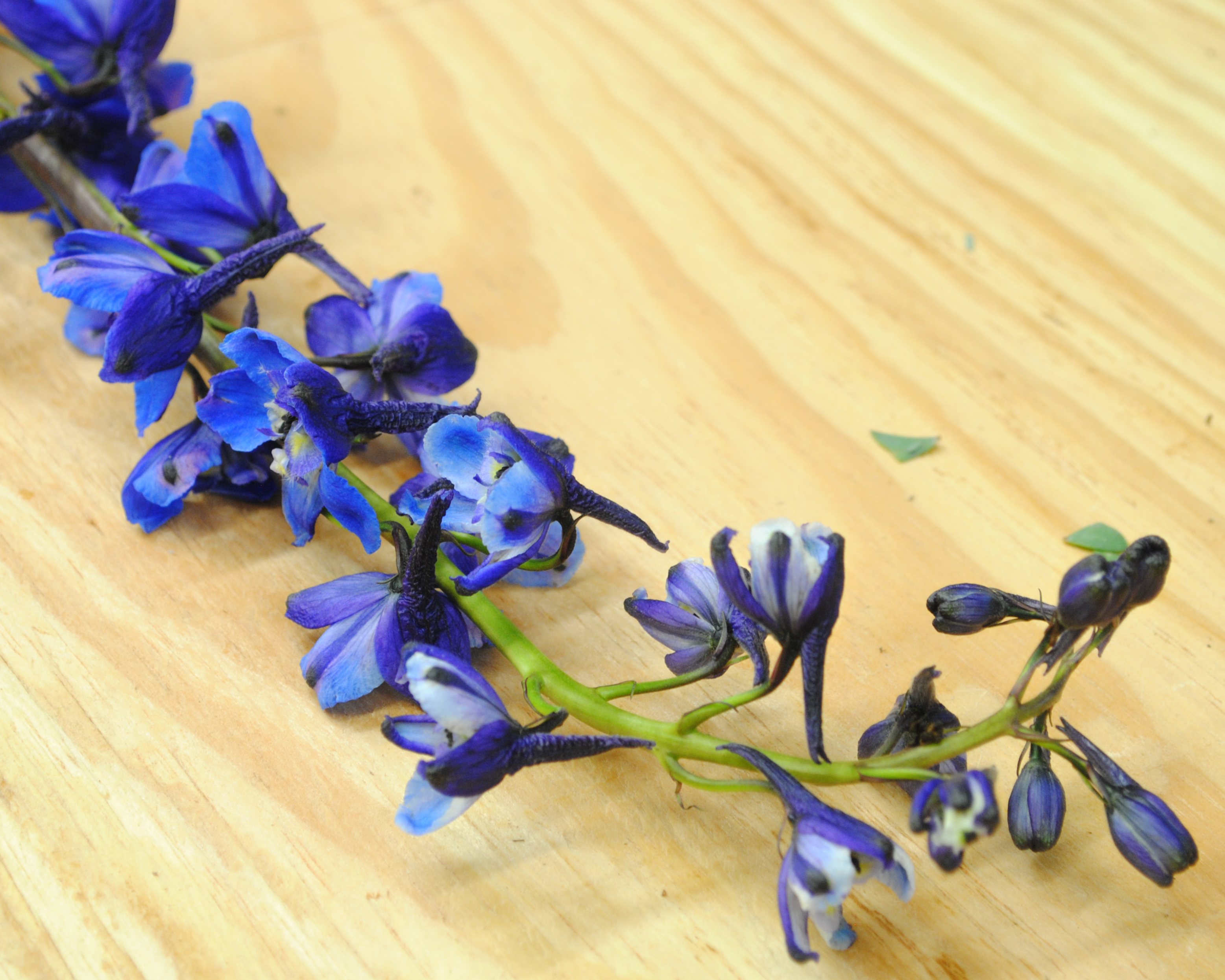
NYC flower shops adore the delphinium for its vibrant blue hue.  The designer’s at Starbright are no exception.  They are a long lasting flower and are ideal to be incorporated in Starbright’s weekly flowers in NYC program. This popular bloom is commonly known as larkspur, but in the shop we call it Delphinium. Delphinium is a large genus of about 300 species of flowering plants that are all categorized in the family Ranunculaceae. Yes, that’s right, despite appearances, the Delphinium is actually a member of the buttercup family (as is the ranunculus, anemone and a bunch of other favorites flowers around the shop). There is a lot of variety amongst the Delphinium genus. Depending on the variety, a delphiniums bloom stalk can be as short as 4 inches to as tall as 2 meters. There are also a variety of colors available, though the classic blue is one of Starbright Floral Design’s favorites, Delphinium varietals can also be available in purple, pink, yellow, and white.

Delphinium Flower History/

Delphinium recieved it’s names from the ancient Greeks who thought that the shape of the nectary looked like that of a leaping dolphin. Many years later, in England, the Delphinium received a new nickname – larskpur – because the shape of the nectary resembled a larks claw. Their popularity increased from there and many hybrids were bred from Delphiums sourced from all over the world. Today’s common delphinium is a product of much cultivation. It is a common flower in gardening shows and is often featured in displays or specialized competitions.

Delphinium Inside Info /
  • Parts of delphinium plants have been used to create blue dyes and inks.
  • Delphinium is highly toxic to people and animals


Starbright Logo


Looking for flowers in New York City? Visit our Event Gallery for inspiration. Or see our daily selection at Starbrightnyc.com.

Starbright NYC Flower Files: Genisteae

Genisteae

Common Broom
Genisteae, Common Broom

Broom Commercial Use /

With it’s small flowers and slender greens, genisteae, also known as broom, has a uniquely airy appearance and sweet smell. Cut broom will last about a week in an arrangement. Top Florists in NYC, including Starbright Floral design, love to use this accent flower in arrangements calling for fragrance. To guarantee longevity of cut broom, and many other flowers, keep these blooms away from ripe fruits and drafty windows.

Broom Notes /

The Broom family of plants include evergreens (plants that are green year-round), semi-evergreens (plants that keep their leaves through winter, replacing them in spring), and deciduous shrubs. The Genisteae family – Brooms are a member – dates all the way back to the Paleogene Period. Genistae are native to many continents in one form or another, but the greatest diversity found among broom plants can be found in the Mediterranean. But wherever they grow, many broom plants share similar characteristics – small leaves and fragrant flowers fixed to flexible slender green stems. The broom flowers are generally yellow, white, orange, red, pink or purple.  

Broom History/

Wayyyy back in the 12th century Geoffrey V, the Count of Anjou, leaned over and plucked a yellow broom plant from the rocky ground and fixed it into his helmet before leading his men into battle. This gesture led to the nickname Geoffrey Plantagenet – Plantaganet can roughly be translated as “Plant Genistrae.” When Geoffrey V later became the Duke of Normandy through conquest, and then the husband of empress dowager Matilda, he became the father of the Plantagenet family. The Plantagenets would go on to rule Britain for 300 years. The conflict that ended their rule was called, believe it or not, the “War of the Roses.”

Inside Info /

Broom has a number of applications, here are some of our favorites :

  • Broom contains tannin, which once-upon-a-time was used to curing leather.
  • Broom branches are slender and flexible. This made them ideal for early sweeping utensils and basket weaving.
  • Though we now consider broom toxic, the seeds were once roasted and used as a substitute for coffee; young shoots were used to replace hops in beer production.
  • Broom can actually help the environment by removing nitrogen from the air.

Starbright Logo

Looking for flowers in New York City? Visit our Event Gallery for inspiration. Or see our daily selection at Starbrightnyc.com.

NYC West Village Flowers- Starbright’s Inspirations Series

Inspired by NYC's West Village
Inspired by NYC’s West Village

New York City flower arrangements and floral designer’s draw their inspiration from all that is beautiful.  NYC neighborhoods each have their own distinct vibe and beauty.  It is this vibe and beauty that our floral designers aim to capture in their NYC flower arrangements.  In this series, Starbright’s Floral designers bring their personal style to the table and mix up something special for their favorite neighborhoods in New York City. The above is an illustration of NYC West Village Flowers inspired by our designer’s artistic floral interpretation of the West Village in NYC available for flower delivery to the West Village NYC!   Watch as an original NYC flowers arrangement is crafted from beginning to end by one of our talented designers.

This week, Byron brings tropicals out to celebrate the life, love, and energy, which makes up the spirit of the West Village in New York City with flowers. First he begins with a classic layer of lemon leaves, followed by hydrangea, amaryllis, bells of Ireland, roses, calla lilies, anthurium, and orchids.

Starbright Logo

Looking for flowers in New York City? Visit our Event Gallery for inspiration. Or see our daily selection at Starbrightnyc.com.

FLOWER FILE : CARNATION

Carnation
Carnation

Carnations

Flower Notes /

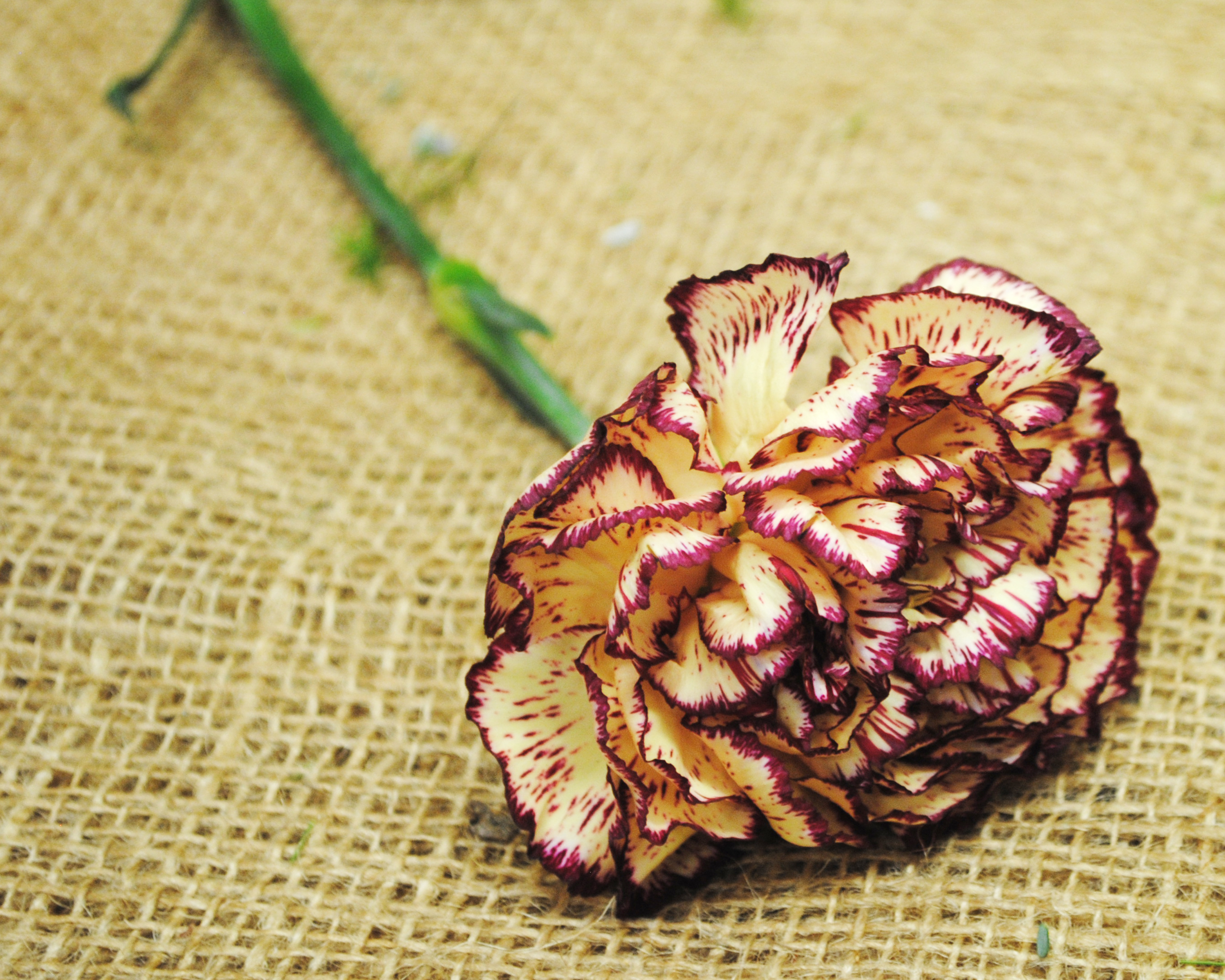
Probably native to the Mediterranean, the carnation has been continuously harvested for over 2,000 years – along with jasmine and roses, carnations are among the three oldest “beauty” crops cultivated by ancient man. Carnations are very, very easy to grow – all they need is full sun, loose neutral soil and a little water. They’re full of symbolism, too – get them in white for someone who could use good luck, like a recent graduate, or for a going-away gift when someone changes jobs. The pink carnation stands for unforgettable love – especially from Mom! The purple carnation symbolizes unpredictability and wit, so it’s good for a birthday or bridal shower. Striped carnations symbolize regret – they’re ideal for funerals. The yellow blooms signify disappointment – this is the perfect bloom for a bouquet that says “I don’t want to date you anymore” (say it with flowers, right?) Be careful giving red carnations – while they stand for “deep love,” they also stand for “socialist” and “irregular military member,” depending on where you are.

Visual Notes:

Some people say that carnations almost look like folded tissue-paper, cinched in the middle and “fluffed up” around the cinch. Other people say these paper flowers look like carnations. Either way, carnations have a unique appearance and are available in a range of colors and patterns – this lets them stand alone in a simple arrangement, star in a busier arrangement, and support their fellow flowers when it’s another bloom’s turn to shine. They are the Ian McKellen of the flower world – they’re great in everything, and your grandmother probably loves them. And in case all the symbolism didn’t make it clear, carnations come in many different colors – your florist should be able to help you source exactly what you’re after.

Flower History Notes:

Since first being cultivated over 2,000 years ago carnations have become one of the most popular flowers in the world. The name comes from (most likely) one of two places – either from the ancient greek  “corone,” or flower garlands worn during formal ceremonies, or from the Latin word “caro,” which means “flesh” (the first carnations were light-pink). Not to get too political, but carnations are among the first GMO-crops – it didn’t take long before ancient farmer-scientists figured out how to breed (repeatedly and reliably!) a whole range of carnation colors.

Carnation Flower Fun For Kids or DYI Decor Needs :

You can make your own color changing carnations! All you need is some food dye, a glass of water (or two, for a special trick) and a white carnation. The basic principle is simple – cut flowers drink the water, the water carries the dye, the dye gets left in the petals. If you split the stem in two (make sure you use a good knife or pair of scissors – and make sure an adult does this part!) and stick it in two glasses with two different colors of water, you’ll get a two-colored flower. You can tell your young’n that the flower is drinking in response to evaporation. The plant is basically like a sponge – as water evaporates off the plant’s leaves and petals, more water moves up the stem to take the evaporated water’s place.


Starbright Logo


Looking for flowers in New York City? Visit our Event Gallery for inspiration. Or see our daily selection at Starbrightnyc.com.


Flower Files: Holly

Holly
Variegated Holly
Quick Notes /

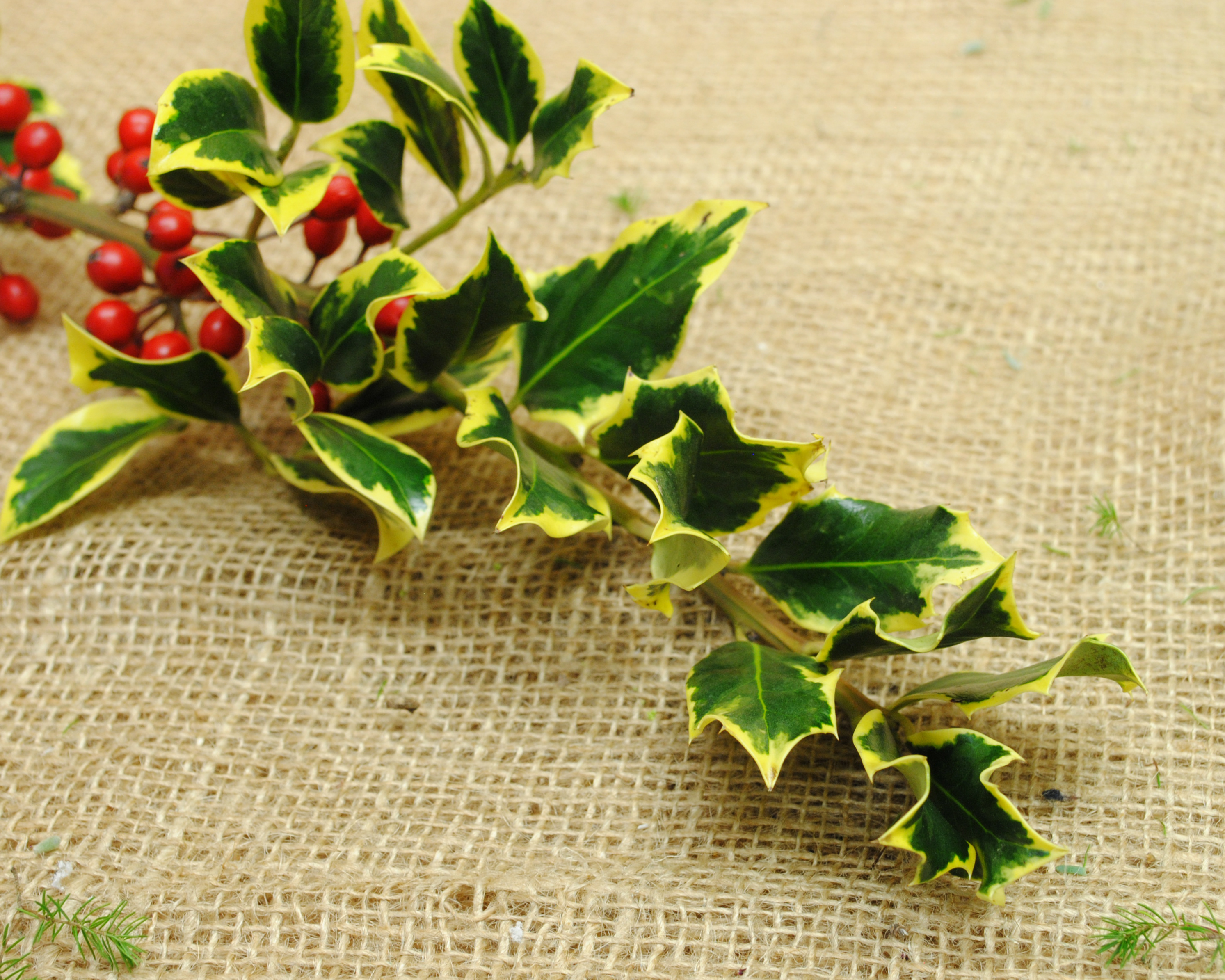
Whether you call it holly, winterberry, inkberry, or yaupon this colorful green is a favorite through the winter. Holly is the general name used for a large number of deciduous and evergreen shrubs and tress that belong to the Aquifoliaceae family and grow in the tropics as well as temperate zones worldwide. The evergreen varieties tend to be more hearty and have a longer vase life than their deciduous counterparts. Holly are notable for their thick, leather-like leaves as well as the bright berries produced by the female holly plant.

Holly History/

Holly have a long history! The variety we know and love, begins to appear about 50 million years ago, while some of the older varieties are now extinct. Holly emerged from the laurel forest, which once covered much of the worlds surface and was able to spread and adapt to all sorts of climates. It’s bright colors and hardy nature captured the interest of many of our ancestors. It was particularly popular in Europe and considered good luck by ancient Druids. Holly was also significant to the ancient Romans who used holly boughs to decorate for the feast of Saturnalia. The practice of using holly boughs as winter decorations continues today in many countries around the word.

Holly Fun Facts /
  • Both the female and male plants produce white flowers, but only the female plants produce berries.
  • A holly tree can live up to 300 years!
  • Have you ever tried Yerba Mate tea? This is a product of the South American holly Ilex paraguarensis


Starbright Logo

Looking for flowers in New York City? Visit our Event Gallery for inspiration. Or see our daily selection at Starbrightnyc.com.
Starbright NYC Flower Files: Hippeastrum (aka Amaryllis)

Amaryllis
Hippeastrum (commonly called Amaryllis)

Hippeastrum aka Amaryllis


Quick Notes /

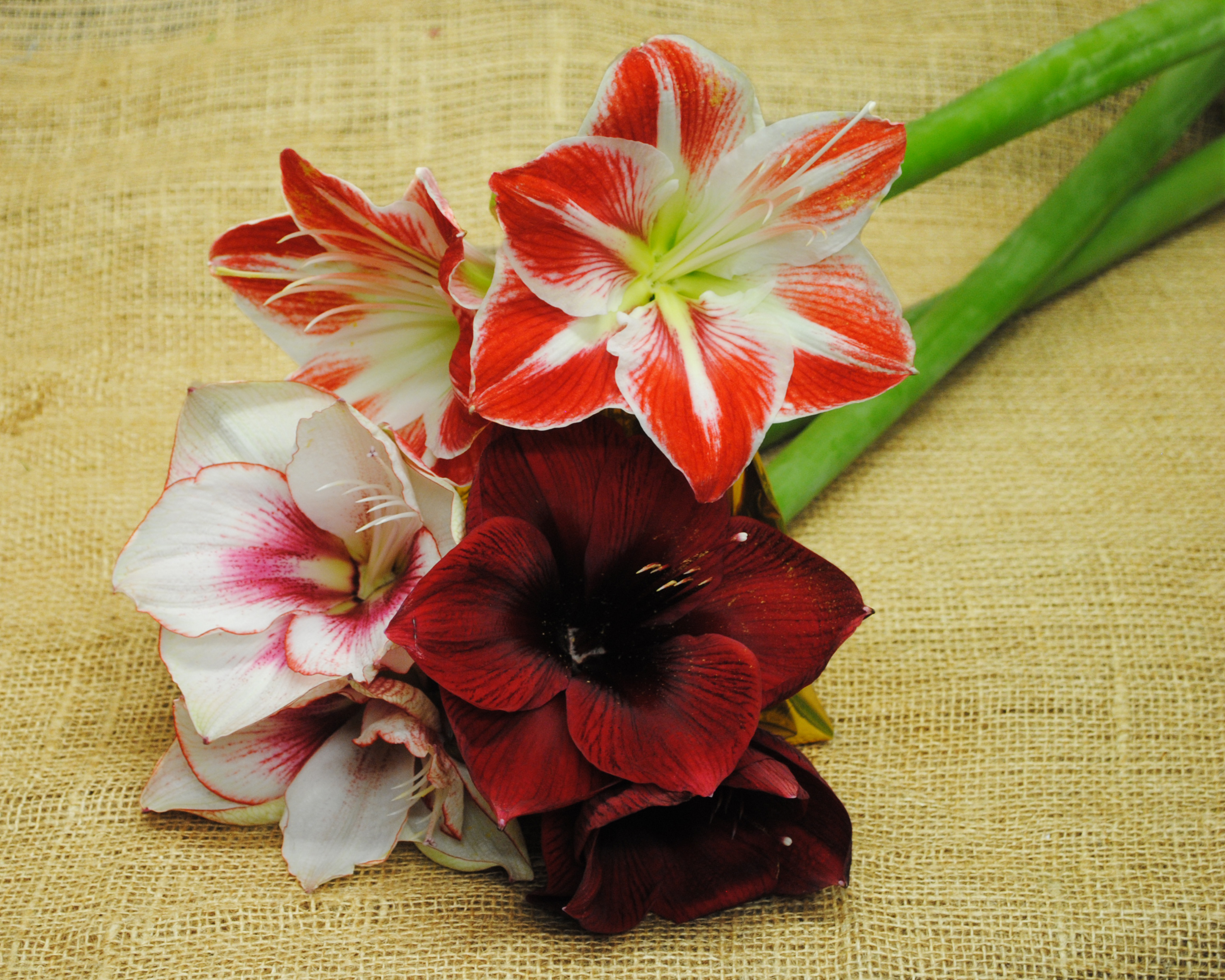
Surprise! This flower, commonly called Amaryllis, is actually a member of the Hippeastrum genus! For years, there was confusion among botanists as to the generic names Amaryllis and Hippeastrum. The debate, it seems began around 1738-1753 and was finally resolved by the 14th International Botanical Congress in 1987. The IBC decided that  the name Amaryllis would belong to the originally identified bloom regardless of common use. So what’s the difference? The Hippeastrum bloom is commonly preferred for it’s ability to bloom indoors during cold winter months in the northern hemisphere while it’s namesake bloom, the actual Amaryllis, grows natively outdoors South Africa and is more commonly referred to as a Lily (though Amaryllis and Lilium, “true lilies” are only very distantly related). This oddly twisted bit of floral folly took over two hundred years to come to terms with. So let’s all do ourselves a favor and just keep on calling this bloom (in all it’s varieties) by it’s common name.


Visual Notes /

These bold trumpet-shaped flowers grow from easy to plant bulbs. Their long hollow stems are accompanied by long flat, sword-shaped leaves. One stem can produce up to six blooms. The blooms range in color from deep bold red to the brightest white and include a number of interesting bi-colored varieties as well.

Flower History/

The name Amaryllis comes from the Idylls of Theocritus or the Eclogues of Virgil (click to read Theocritus’ Idylls). In this pastoral poem, Amaryllis is a sweetly-singing shepherdess who is in love with a cold-hearted man. Desperately, Amaryllis pierced her heart with a golden arrow then, inexplicably, trekked to his cottage day after day for an entire month, shedding drops of blood along the way. On the thirtieth day blood-red blooms blossomed from the drops, the man was enchanted by the flowers, Amaryllis’s heart was healed and they lived happily ever after.

Inside Info /
  • The US imports over 10 million Amaryllis bulbs a year.
  • The name Amaryllis comes from Greek “to sparkle”
  •  The name Hippeasrtum, also from Greek means “horseman’s star”.


Starbright Logo

Looking for flowers in New York City? Visit our Event Gallery for inspiration. Or see our daily selection at Starbrightnyc.com.
Celebrate the Holidays with Starbright NYC and Teleflora’s Homemade For The Holidays Collection

Nic and Jasmine at Starbright NYC

Starbright celebrates the holidays with Teleflora in New York City!

Hanging on various walls and scattered throughout the shop, are a number of plaques proclaiming Starbright Floral Design as one of the top 50 sellers in the Teleflora network. It’s a great place to be – in the Top 50 of a network including more than 15,000 member florists in the US and Canada. For over twenty years now, Starbright Floral Design has filled and sent orders to this network of talented florists. We’re all unique shops, many of us with our own unique styles, but together, with the stellar design direction of the Teleflora team florists all over are able to send exactly what you’re looking for. 

Earlier this week, Jasmine Corzo, a familiar face from the Teleflora design team, stopped into Starbright Floral Design with a camera crew, some clippers and a plan to introduce us to the Telefora holiday centerpieces and seasonal lineup collection for 2014.

Thomas Kinkade's Holiday Arrangement
Thomas Kinkade’s Meet Me Under The Mistletoe

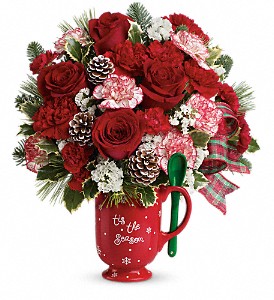
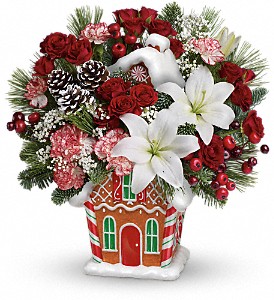
The Teleflora arrangements this year remind us of being home for the holidays. The designs include traditional premium floral varieties, which bring out the colors of the season. Pieces like Teleflora’s Candy Cottage and Thomas Kinkade’s Meet Me Under The Mistletoe include winter greens like white pine and noble fir with snowy bright whites and velvety deep reds. Frosted pinecones and peppermint carnations, and big red berries are playful seasonal favorites that add great texture to these lush pieces. But it’s not just about the flowers!

Warm Wishes
Teleflora’s Warm Holiday Wishes Bouquet
Candy Cottage
Teleflora’s Candy Cottage Bouquet

Many of the Teleflora holiday arrangements are made to fit a special seasonal keepsake. While the premium flowers used in these arrangements have a great vase life, the vase they come in will surely be a longtime favorite. You’ll want to bring these cookie jars, mugs, and decorative vases out year after year and reminisce about when Aunt Ana, Grandpa Redd, or your nephew Hugo sent you flowers.

But Wait! There’s more!

As if the fancy flowers and festive vases aren’t enough, sending any item from the Teleflora Homemade For The Holidays Collection comes with a chance to enter their Holiday Sweepstakes to win a trip to NYC!

Starbright Logo

Looking for flowers in New York City? Visit our Event Gallery for inspiration. Or see our daily selection at Starbrightnyc.com.

NYC Holiday Flower Files: Pointsettia

Poinsettia
Poinsettia

Poinsettia Facts

Poinsettia Quick Notes /

A popular floral symbol of the Christmas Season, Pointsettias are indigenous to Mexico and Central America. The poinsettia plant generally grows to be between two feet and thirteen feet tall. The common English name – poinsettia – comes from the last name of Joel Roberts Poinsett, the first United States Minister to Mexico. Mr. Poinsett introduced the plant to the US in 1825.

Poinsettia Visual Notes /

The large dark green dentate leaves grow lower on the stem than the colored bracts, which are often mistaken for petals. The colored bracts are available in white, cream, pale green, pink, orange, marbled, or the most popular – bright red. The color of the bracts is affected by photoperiodism. Photoperiodism is a physiological reaction caused by the length of daylight or night. Poinsettias are peculiar in that their bracts require at least twelve hours of darkness in order to change color, but also exposure to bright light to deepen the shade of the color. The flowers of the poinsettia are tiny and unassuming.  Their yellow structures cluster in the center of the leaves.

Poinsettia
Poinsettia


Poinsettia Flower History/

The poinsettia has been called many things over the years and around the globe. The original name for the poinsettia plant is Cuetlaxochitl, which is Nahuatl for “flower that grows in residues or soil”. The ancient Aztec used the Cuetlaxochitl bracts for their red dye and as a medicine. In Mexico, the poinsettia is called flor de noche buena or “Christmas Eve flower” while in some other Spanish speaking countries it is called flor de pascua or “Easter flower”.  In Egypt, the name Bent El Consul translates as “the consul’s daughter” – in honor of Mr. Poinsett.

In the US, the poinsettia was popularized by the Ecke family in California who first sold poinsettia plants at street stands during the Holiday Season. After three generations of cultivating the plants, Paul Ecke Jr. solidified the plants Holiday association by sending free poinsettia plants to television stations from Thanksgiving to Christmas to be displayed on the air.

Poinsettia Inside Info /

  • Keep your poinsettia healthy by following these pointers
    • Water the soil when it begins to dry (aim for moist, but not soggy).
    • Keep the plant away from hot or cold drafts (a general temperature of 60-70 degrees fahrenheit is best)
    • Expose the plant to natural light
  • Despite popular belief, the Poinsettia is not poisonous – it’s been cleared of all charges by the American Medical Association.
  • Poinsettia plants will change color year after year with a little bit of work. Beginning in October, stash your plants in total darkness from 5pm to 7am and then expose them to full sun. Repeat every day and in eight to ten weeks, your poinsettia bracts should be changing color.


Starbright Logo

Looking for flowers in New York City? Visit our Event Gallery for inspiration. Or see our daily selection at Starbrightnyc.com.